Saturday, August 21, 2021

#980 GAMA – OPEL REKORD, ASCONA and CORSA (893, 1140, 1159, 1176) (1978, 1981, 1983, 1984)

This is my second entry showing Gama die-cast cars. In the previous occasion, I showed a 60s Porsche Carrera in 1:43 scale, and this time I am showing four Opel/Vauxhall models from the late 70s and the 80s.

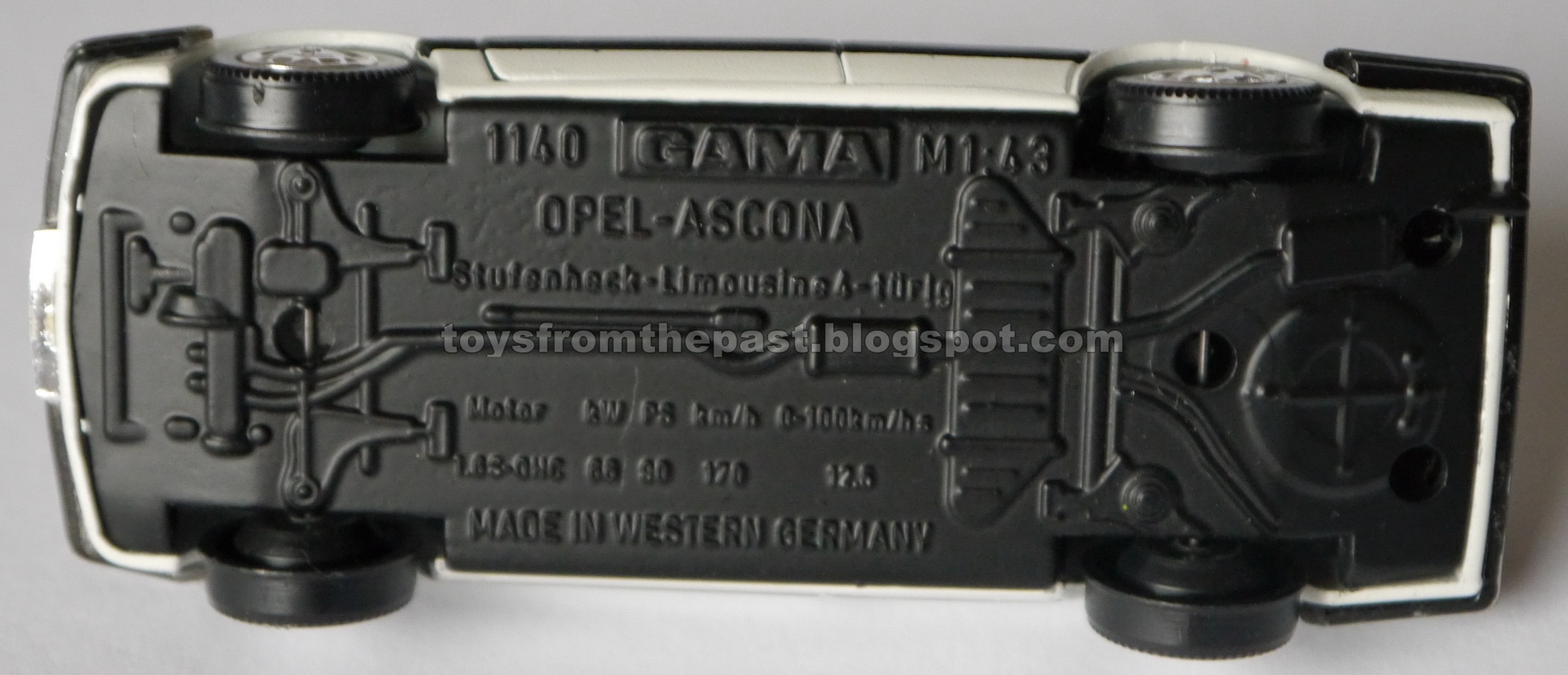
Not to repeat everything four times, I would like to summarize the common characteristics of these models. They are all 1:43 scale die-cast, have practicable parts, detailed interiors and the base include not only the name of the car, brand, etc., but also some technical specs for a particular model such as speed, power and 0-100 km acceleration time.

I would say they are all excellent, you cannot really confuse the models with any other Opels and the combination of metal and plastic parts, some of them painted in two colours shows probably the most accurate representation of the models available at the time. All these and most Gama I have seen on the Internet are in very good condition, so probably they were not really intended for children, but adult collectors, or they had an astounding paint quality, or, most probably, both at the same time.

They were marketed under the GAMAmini brand and sold in cardboard boxes with windows, but I also suspect they were sold at Opel athorised dealers to owners of the real cars or car enthusiasts in general.

So, chronologically…

Opel Rekord Limousine 4-Türig (893) / Vauxhall Carlton


The real model was for sale between 1977 and 1982, and this toy was probably made in 1978. It is the oldest model in the lot and was manufactured in Hong-Kong, while all the others were manufactured in Western-Germany. Curious that the production was moved from Hong-Kong to Germany and not the other way round, how did that happen? Hong-Kong marked models seem to be somewhat rarer than the German ones, and also more exensive, although any of these can be easily found on eBay or similar sites.


Opel Ascona Stufenheck-Limousine 4-Türig (1140) / Vauxhall Cavalier

This thrid version of the ascona premiered in 1981 and wasn’t modified until 1984. It represesented the mid-upper-range car by Opel between Rekord and Kadett. After a facelift, it was still sold untl 1988, and then it was replaced by the Opel Astra. This model was far more common than the Rekord on the streets when I was a child, but still a good expensive car.



Opel Corsa SR (1159) / Vauxhall Nova

At the time, he smallest Opel available, this car was expremely popular at the time. It was launched in 1982 and wasn’t modified until 1985, although not much. I recall this car as a kid, and I even travelled in it a couple of times, maybe because of this, it is my favorite model. Note that it has a practicable trunk door, but the bonnet cannot be opened, as it was the case of the Ascona. The other two models have both practicable trunk and bonnet parts.


Opel Rekord Limousine 4-Türig (1176) / Vauxhall Carlton

This car is the 1983-facelift Rekord that we have just seen before. It would remain for sale until 1986, when it was replaced by the Opel Omega. It is interesting to compare this model with the pre-facelift one, and see, for example, that the base is exactly the same, and the bodies also very similar to each other, I would say the main structure is exactly the same, and only the practicable parts and the front and back plastic pieces are different.


I bought altogether in the last half of 2019 for 5 euro/piece.


FACTS AND FIGURES:

  • Name: OPEL REKORD, ASCONA and CORSA (893, 1140, 1159, 1176)
  • Scale: 1:43
  • Year: 1978, 1981, 1983, 1984
  • Company: Gama (Germany/Hong-Kong)
  • Size: Around 9 cm

Sunday, August 8, 2021

#979 HOT WHEELS! - ATTACK TRACK BIG BONES (Ref. 1853) (1992)

This is one of the biggest models of the Attack Track series, but not necessarily the people’s favorite. It can still be found for very little money in auction sites.


The car reveals a monster with three mouths, one on the cab and two more on the front wheels, and this makes it roll with difficulty. I think Mattel should have solved this in a better way. This is its greatest flaw. The rear hook/crane and the bed with the bones cage are excellent, and you can really trap one of the smaller, ordinary cars, this gives it more playability than any other feature.


The name “Big Bones” refers probably to this cage, and I think it is well chosen. I guess it sold very well due to the artwork on the box, as the concept is much better than the realization of the toy. There were other bigger trucks in this collection, but they were surprisingly, very different to each other.


The toy is made of plastic, so it is also light and rather simple. It is decorated with some stickers, but these are not really very good. I would like to see more stickers and more colours in truck form. The chromed motor and front, as well as the exhaust pipes are good, but not great.


FACTS AND FIGURES:

  • Name: ATTACK PACK BIG BONES (Ref. 1853)
  • Scale: Unknown
  • Year: 1992
  • Company: Hot Wheels!/Mattel (U.S.A.)
  • Size: approx. 20 cm

Friday, July 23, 2021

#978 HERACLIO-FOURNIER – BARAJA OLÍMPICA (1988)

The Olympic Games from 2020 in Tokyo have finally started. The opening ceremony was celebrated today, so I will comment this deck of cards made by Heraclio Fournier in Spain in 1988, when the games were celebrated in Seoul.

It is one of my favorite H-F models, as it has really well done illustrations of many olympic sports. There are 32 cards, although some cards represent several similar events. For example, the card for cycling counts for indoor and route cycling.


Some cards has short descriptions of the event(s) or categories, other have a listing of world records, both for men and women. Unfortunately, all drawings show men, it would have been great if half of the cards would show female athletes. Interestingly the box depicts a female gymnast, which does not appear in any of the cards. Probably they noticed the error and tried to correct it by choosing that cover.

The set includes a 3rd cover card with the instructions on the back. Heraclio-Fournier had another, much older, sports deck, but the drawings were made in a completely different style.

FACTS AND FIGURES:

  • Name: BARAJA OLÍMPICA
  • Year: 1988
  • Company: Heraclio-Fournier (Spain)

Thursday, July 8, 2021

#977 MAISTO – FERRARI COLLECTION (Around 1995)

This is a rather common gift set from the mid-90s made by Maisto that, at the time, was entering most Western markets with great force, and taking advantage of the relative weakness of more traditional brands, such as Matchbox or Majorette.

I am not a Maisto collector, but a MC Toy one, and I already have all these cars with the pre-maisto brand in their bases, but not all in red and/or mint condition. And, on top of that, it was a very cheap set, so I could let it go.

The models were great at the time, and were also priced much lower than the other brands.

The box has 5 windows and includes 5 Ferrari models: F40, 365 GTB, 308 GTB, Testarossa and 250 GTO. The box is way to big for its content, more if we consider the upper flap from where it could be hang from a display.


You can see other MC Toy Ferraris here. MC Toy models were unlicensed, were these early Maistos really Ferrari licensed products, or is the seal at the back of the box a fake?

FACTS AND FIGURES:

  • Name: FERRARI COLLECTION (FERRARI F40, 365 GTB, 308 GTB, Testarossa and 250 GTO)
  • Scale: 1:64 (approx.)
  • Year: Around 1995
  • Company: Maisto (China)
  • Size: Around 7 cm

Wednesday, June 23, 2021

#976 BUDGIE – PANTECHNICON REMOVAL VAN (Nº58) (1960)

Budgie is one of the brands from which, being relatively well known, I never owned any models at all. It was first one year ago that I got my first Budgie from a friend. I guess that at the time they were made, not many were exported, and therefore, they are very difficult to find outside of the United Kingdom.

Budgie history has been extensively covered in books and Internet sites, so I will skip most of it. I’d just like to point out a few facts about the company. Before changing its name to Budgie, the manufacturer operated in London under the name Morestone, or Morris & Stone, the name of its founders. This was as early as the 1940s. Interestingly, some Pre-Budgie models are marked “Modern” or “Modern Products”, as they were produced by a different company by that name.

The brand Budgie was first used in 1959, but not for long. The company was sold in 1961 to S. Guiterman and went out of business in 1966. Modern Products continued the production until 1969, and the casts passed that same 1966 to H. Seener Ltd., who specialized in die-cast cars for the tourist market, either under Seener or Seerol brands. These models were actually casted by Corgi in Swansea, as Seener had no factory or production means. It is difficult to give an exact date of when were these models discontinued, as there was still one more owner for the casts, a company called Starcourt. Recently (since 2017) DG Copy Models is offering Budgie Models based on the original castings. Zebra Toys and Autocraft/DGM also made models based on old Morestone casts.

During the 40s and 50s, Budgie was best known for its horse carriages and stagecoaches, or horse-drawn vehicles in general.
 
Budgie toys are slightly smaller than the classic Matchbox toy and had a poorer paintwork, they also could not adapt very quickly to the quality level of this competitor, or the first Hot Wheels. 

I have only this small truck, which is really beautiful. Reminds of early Lesneys with casted wheels. I think from all the available colours, this shade of green was the latest one used, but it is also the one I like most, ast the beige/cream and light brown colours are too similar to the colour of the decal applied on both sides of the van.

The rear door can be opened, and small items can be kept in the box, so it is quite playable as well. Nice!

FACTS AND FIGURES:

  • Name: PANTECHNICOLN REMOVAL VAN (Nº58)
  • Scale: 1:100 (approx.)
  • Year: 1960
  • Company: Budgie Toys (Great Britain)
  • Size: Around 5 cm