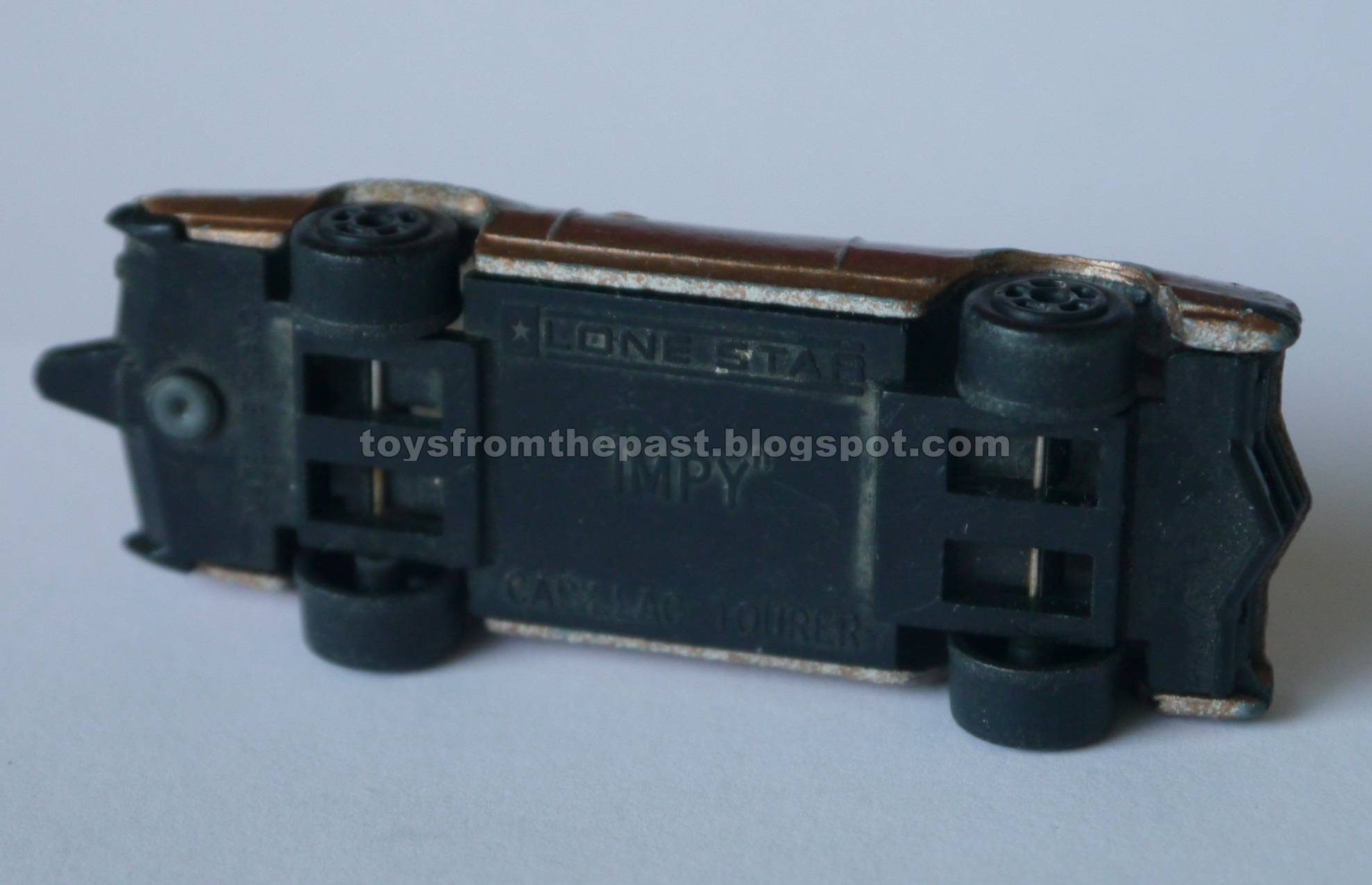
As time goes by, we have seen websites dealing with die-cast models disappear. Great and free sources of information are lost and there is no way to get them back. However, one website that is still operative, since more than 20 years is: www.robertnewson.co.uk/articles/LoneStarImpy/index.html
There you can read the history and a chronological scroll of events, improvements, production, subseries and all related to Lone Star. The article goes back to 2003, when this brand was featured in the Diecast Collector magazine, and a sudden interest woke up. Taking this website as a reference, I mad a list of the models released and I summarised the history of the company, for me to keep track of the models I have and to which series do they belong.
Lone Star has been always rare to spot as they were not so popular as Corgi, Matchbox or Dinky in the United Kingdom and elsewhere. What I didn´t know if that Lone Star was more focused in toy guns and other toys, while diecast vehicles were only offered intermittently, even updating or revamping casts as they were not so actual anymore.
The company was founded in 1939 by Bob Mills and Sidney Ambridge in Palmers Green, London. Originally, they manufacted diecasting machines, and so the complete name of the company from 1940 onwards was Die Casting Machine Tools Ltd. (short: DCMT). There is evidence that many diecast firms after the war, including Matchbox, Modern Products and Kemlows used DCMT machinery and that both Matchbox founders Jack Odell and Rodney Smith worked for the company before starting their own business. One of the most popular models of DCMT was the M55 diecasting machine.
As they saw the commercial success of companies using their machines, they also started producing their first toys in 1946, so shortly after the three cited above. Initially, DCMT were only manufacturers, and the company The Crescent Toys Ltd. was acting as a distributor. These very first models included the Crescent Jaguar Saloon, hugely popular at the time. They also copied some casts from Tootsietoys. This situation remained until January of 1950, where they decided to stop the contract with Crescent and distribute their own products directly to wholesalers. They changed the name to Slikka Toy during approximately one year, and, in 1951, they changed it again to Lone Star. They had already many toy guns, and this second and final name was chosen because it was already registered and in use for several cowboy outfit sets. Business was going great and they opened new factories in other placed in England, such as Hertfordshire.
Theis most famous vehicle lines were the Roadmasters (1956-1969), Impy (1966-1968), Flyers and Commercials (1970-1972, although some were revamped later) and Impy Super Models (1976-1980).
The Roadmasters debuted in 1956 with a series of sport cars and classic cars in 1:35 scale. They were fragile, because the base and wheels were made of plastic. With the years, there were more models and other scales (such as thirteen models in 1:50, large scale trucks and planes in 1:250 scale). They didn´t have much success.
The Impys were a new trial to compete against the established manufacturers, and have nothing in common with the Roadmasters. They started in 1966 and despite the small scale, Lone Star wanted to include a lot of features, that is, windows, interior, suspension, jewelled headlights, steering wheels and practicable parts (more parts than Corgi or Matchbox, often doors, bonnet and trunk). The price was slightly higher than the similar models, but the toy itself was also a bit bigger in size (3 inches long). With the time, the features were cut, while the concurrence were adding more and more features while keeping the price tag stable. Lone Star was broadly advertised in children´s press and collectors magazines.
Unfortunately, the models are not very well casted and proportions do not match with the real models.
Other names used for the line were Lone Star Roadmaster Impy Super Cars.
Each model was typically available in more than one colour.
1966 Models (priced 2s11d)
- Nr.10 Jaguar Mk.X (1:64)
- Nr.11 Chevrolet Corvette Stingray (named Gran Turismo Coupe, probably due to a missing license) (1:58)
- Nr.12 1963 Chrysler Imperial (1:73)
- Nr.13 Ford Thunderbird (unreleased)
- Nr.14 Ford Zodiac Mk.III Estate (1:59)
- Nr.15 Volkswagen Microbus (1:59)
- Nr.16 Motorway Police Patrol Car (nr. 14 or nr. 12 with siren and POLICE decoration) / Variants: Mercedes 220E (nr.17 in dark green “POLIZEI” for Germany, “POLIS” Mercedes for Sweden and “POLITIE” Chrysler for the Netherlands).
- Nr.17 Mercedes 220E (1:63)
- Nr.18 Ford Corsair (1:58)
1967 Models (priced 3s) and Accessories
- Nr.19 Volvo 1800S
- Nr.20 VW Microbus ambulance (based on nr.15 with slight changes in the interior and siren) / variant with POLITIE for the Dutch market.
- Nr.21 Fiat 2300S Coupe (scale 1:59)
- Nr.22 Rolls-Royce Silver Cloud Convertible
- Nr.23 Alfa Romeo Giulia 1600 Spider
- Nr.24 Foden 8-wheel tipper
- Nr.25 International tractor
- Nr.26 Foden Petrol Tanker (announced as Foden Bulk Sugar Transporter) (Same as 24 with Tanker “Mobile”, rare variant “SHELL”)
- Nr.27 Ford Taunus 12M
- Nr.28 Peugeot 404
- Nr.29 Cement Mixer Lorry (announced 1967, but was unavailable until 1969)
- Nr.30 Merryweather Fire Engine
- Nr.31 Ford Transit Breakdown Lorry “ESSO”
- Nr.401 Car Lifting Ramp, price 3s 11d
- Nr.402 Lock-Up Garage, price 1s 6d
- Nr.403 Service Station (unreleased)
1968 Models (priced 3s6d) and Accessories
- Nr.32 Fire Chief version of the Ford Corsair (with siren and FIRE CHIEF decoration) / variant: FEUERWEHR for Germany
- Nr.33 BLH Austin-Western Model 220 Mobile Crane
- Nr.34 Euclid 82-80 Twin Power Crawler Tractor
- Nr.35 Articulated Flat Truck (unreleased)
- Nr.36 Lotus Europa (announced but unavailable until 1969)
- Nr.404 'Mobil' Petrol Pump Island with canopy and a 'Mobil' forecourt sign (prized 4s9d)
- Nr.405, a new two-tier Service Station (unreleased)
The Flyers was a series conceived in 1968, that is why the Impy models from that year are all repaints, but released in 1969. In 1968, the Hot Wheels range was introduced in most markets, so every other company had to react to it. The new Flyers started with the old Impys in new wheels (although these were rebranded as Lone Star Commercials. They mounted new ultra-thin axles with a plastic piece on top to implement the suspension. The wheels were designed new and the base was screwed instead of rivetted. The steering feature was completely removed. Some tracks were also available. All these actions made Lone Star the fastest competitor in Britain to adapt to the new hot wheels trend (around 6 months ahead of Matchbox´s Superfast and 9 months ahead of Corgi Rockets). The price continued to be a disadvantage.
Flyers lost the jeweled headlights, but got more attractive painting and decorations. They were promoted as a cereal giveaway. On every package was one of six models available and a leaflet catalogue.
1969 Flyers models (priced 3s6d)
The 18 Flyers models comprised the 16 cars from the Impy series and two new additions.
- Nr. 36 Lotus Europa (appeared late in 1969)
- Nr. 9 Maserati Mistral GT Coupe (spelled 'Mistrale') (1970)
- Nr. 29 Foden eight-wheel “Lucas Battteries” (not Flyer, but Commercial)
One new Commercial appeared in 1969 as no.29, using the Foden eight-wheel cab/chassis with a new plastic body representing a canvas side type of box van. This had 'Lucas Batteries' transfers, changed in 1970 to 'Express Freight' labels. Later there was a special issue of this model for Japan with labels in Japanese characters which translate (I am told) as 'National Railway Container'.
- Nr. 403 Fire Station (same as lock-up Garage) with small variations. Probably unreleased.
- Nr. 414 Same with a fire engine and fire chief's car. Probably unreleased.
1970 Flyers models (price: 3s9d)
- Nr. 37 Ford GT40 (never released)
- Nr. 38 Chevrolet Corvette Stingray (new cast), a more up to date car than the old Corvette, which was still no.11. The model was spoiled by ill-fitting doors.
- Nr. 39 Ford Mustang.
- Nr. 40 Cadillac did not appear till 1976, by which time it had lost its planned opening doors, bonnet and boot.
- Nr.8 Ford Capri (never issued, listed in the catalogue without illustration)
- Nr.13 Toyota 2000GT (never issued, listed in the catalogue without illustration) coloured plated finish similar to Corgi Rockets or standard paint.
1971 Flyers models (new wheel model with five spokes) (price: 4s6d)
New wheels and the Firenza
- Nr. 13 Toyota 2000GT
- Nr. 38 Chevrolet Corvette Stingray
- Nr. 39 Ford Mustang
- Nr. 8 Ford Capri
- Nr. 7 Vauxhall Firenza (launched together with the real model, several colours and “Budget Rent a Car” version) (priced 5s or 25p). There is also a variant with the steering wheel to the left, in which Vauxhall has been casted off the base and the rear part of the body for the Canadian market.
1972 New Commercials
The commercials got new wheels on 1972, except the tractor and the crane.
- Nr. 41 Builders Supply Lorry (with plastic girders)
- Nr. 42 Foden S50 Half Cab “Tilcon” (variant of Nr. 24)
- Nr. 43 Routemaster Bus (shown in the catalogue but not sold as Commercial, but with Nr. 1259)
- Nr. 44 Marine Transport Lorry (with plastic speedboat)
- Nr. 8 Ford Capri (for the third year in a row, it went unproduced)
After 1972, the company could not continue with the production as until that time. The founder Bob Mills died in June 1973. What followed was no match for what they had done in the past. There were no changes in the products offered until 1975.
That year, some Commercial models were simplified to keep the prices as low as possible. Many plastic parts replaced metallic ones, some parts were redesigned to fit several models, and 8-wheelers turned 6-wheelers. The same happened to the flyers, where practicable parts disappeared, windows became black and plastic was used on the bases and accessories. Nr. 40 Cadillac Eldorado was finally added to the collection.
1975 was the last year for the Commercials, as they were replaced in 1976 by the Impy Trucks These are the trucks I have shown in this blog before: generic, sharing common parts, not very interesting for collectors.
The same happened to the Flyers in 1976. From 1978 on, the Impy car range was simplified to a greater extent: no opening parts, black windows, no interior, plastic base…
- Nr. 71 Range Rover
- Nr. 72 Cadillac Eldorado (previously Nr. 40)
- Nr. 73 Chevrolet Corvette Stingray (previously Nr. 38)
- Nr. 74 Toyota 2000GT (previously Nr. 13)
- Nr. 75 Police Range Rover (also Ambulance in set with Police version)
- Nr. 76 GT Rally (Chevrolet Corvette previously Nr. 11)
In 1979, the line was extended:
- Nr. 77 Jaguar XJ6 (previously Nr. 10)
- Nr. 78 Maserati (previously Nr. 9)
- Nr. 79 Ford Mustang (previously Nr. 39)
- Nr. 80 Lotus (previously Nr. 36)
- Nr. 81 Volvo 262 Coupé (new)
- Nr. 82 Mercedes (new)
The production and the business continued decreasing over the years. In 1983, the company went into receivership and the toy division sold. The production moved to Asia in 1988.
FACTS AND FIGURES:
- Name: RANGE ROVER, CADILLAC ELDORADO & JAGUAR (Nr. 71, 72 & 79)
- Scale: Approximately 1:55-1:64
- Year: 1976 (Nr. 71 & 72) and 1979 (Nr. 79)
- Company: Lone Star (Great Britain)
- Size: approx. 8 cm