Showing posts with label Portugal. Show all posts

Monday, October 20, 2025

#1080 MAJORETTE SUPER CRISTAL - NISSAN TERRANO, VW COMBI CARAVELLE and HONDA NSX (107, 113 and 117) (1994)


I had interesting conversations with other collectors and miniature car enthusiasts regarding Novacar and the portuguese Majorettes since I started this blog, so I am happy to publish again something related to this particular topic.

I bought these three Majorette Super Crystal blisterpacks from eBay in October 2019, together with other boxed Majorettes and Zylmex, but this is the pace of this blog, it takes years to find a gap to be published!


The Super Crystal models from Majorette have a die-cast base and a plastic body, which allowed to make them transparent and include (or not) glitter in the plastic component. The cars look very different to any other die-cast model or subline and are commonly misregarded by most serious collectors. Still, they are nice toys, and also rare. The interior can be seen from the outside better than in die-cast models, and they remind a little bit of Micro Machines X-Rays, which are slightly older than these. Maybe was it an inspiration for Majorette?

There are not many models available (less than in the original Novacar reference list), but each of them could be found in different colours, so if you are a completists, I have bad news for you: One single cast can appear in up to 10 different „clear“ colours plus the same 10 colours plus „glitter“. I´ll try to list the colours first:
  • Green, dark green, lime green
  • Red, dark red, purple, pink
  • Transparent
  • Blue, turquoise
Now, let´s list the models. They use the same reference numbers as the original Novacar (as they share the chassis), but you´ll notice that there are some numbers missing in between. For example, number 101, which was a Ferrari 348 GTB is not available as a Super Crystal. Why? Nobady knows, but most probably it is because it would have been so similar to the 104 Ferrari Testarossa, that they would have been difficult to differentiate. Note that the details are more difficult to perceive in this shiny transparent body.  

Number 106 Peugeot 605 is also missing from the list (was it also too generic in its shape?), and there is also no trace of the two Formula ones  (these were probably not feasible with the glittery plastic compound or the spoilers couldn´t be made in glittery plastic, so they may have looked strange as prototypes.


So the complete list of Super Crystals is this one:

Serie 280 “Super Crystal”
  • 102 – Nissan 300 ZX
  • 103 – Chevrolet Corvette (’83)
  • 104 – Ferrari Testarossa
  • 105 – Mercedes 500 SL (Cabrio)
  • 107 – Nissan Terrano (here presented in glittery green)
  • 108 – Kenworth (T600)
  • 109 – (Chevrolet) Impala Police
  • 110 – Renault Espace
  • 111 – Sport Proto (Porsche 962 Group C Racer)
  • 113 – Combi VW Caravelle (here presented in glittery purple)
  • 116 – Pick Up Chevrolet
  • 117 – Honda NSX (here presented in clear transparent)
The cars could be purchased in single blisterpacks, like the ones I have, but also in double blisterpacks, but I have no notice of bigger boxes or gift sets. Of course, they were cheaper to produce than the standard die-cast series, but the shiny looking made them special so the gain per unit sold was probably great. Unfortunately, the sales were not good, and the line was discontinued after two years. They appear in the Majorette catalogues between 1994 and 1996, year in which the portuguese factory of  Paredes was closed (together with some other in France) and a big part of the prodcution moved to Thailand.


1996 Catalogue


FACTS AND FIGURES: 
  • Name:  NISSAN TERRANO, VW COMBI CARAVELLE and HONDA NSX (107, 113 and 117)
  • Scale: 1:64
  • Year: 1994
  • Company: Majorette (France/Portugal)
  • Size: approx. 7 cm

Sunday, June 6, 2021

#975 NOVACAR – NISSAN 300 ZX, FERRARI TESTAROSSA, MERCEDES 500 SL (CABRIO), KENWORTH (T600) (1994)

This is a set of four vehicles I exchanged with a friend around 2 years ago. I think my first Novacar entry is quite complete, and has been quite successful, being even translated in message boards as well as referenced many times, so I won’t make any more references to the history of the brand or the series they produced.

We can take a look at the packaging, as this time, all four models are mint on package. Unfortunately, all cards are the same. They are not very elaborated, colourful and rather small. The card shows a three-lane road with two Lamborghini Countachs. The only difference among all four lies in the bubbles, which are different sizes to fit different models. The back part shows the safety instructions in many languages: Portuguese, English, French, Dutch, German, Spanish, Italian, Danish, Swedish and Greek, so we can figure out it was exported to all these countries and more.


The cars are all from 1994, and, therefore, the first decoration of the two available:

  • 102 – Nissan 300 ZX in light blue
  • 104 – Ferrari Testarossa in red
  • 105 – Mercedes 500 SL (Cabrio) in grey
  • 108 – Kenworth (T600) in blue


The cars have nice colours and/or tampographies, especially the Nissan and the Kenworth. The Ferrari Testarossa might be confused with the 348 GTB, which is reference 101. Both models are very similar, and exchanged their colours in their first and second decoration. The 348 was yellow in 1994 and red in 1995, and the Testarossa was red (this one in the pictures) in 1994 and yellow in 1995.

FACTS AND FIGURES:

  • Name: NISSAN 300 ZX, FERRARI TESTAROSSA, MERCEDES 500 SL (CABRIO), KENWORTH (T600) (Ref. 102, 104, 105 and 108)
  • Scale: 1:64 (approx.)
  • Year: 1994
  • Company: Novacar (Portugal) / Majorette (France)
  • Size: Around 7 cm

Saturday, September 14, 2013

#325 NOVACAR – FERRARI 348 and RENAULT ESPACE (Nr. 101 and 110) (1994)


FACTS ABOUT NOVACAR / HISTORY OF NOVACAR

Novacar is a commercial name used by a Portuguese company for car miniatures made of plastic with a die-cast chassis. Very little is known about it, so I have tried to collect as much information as possible from different sites and images in the internet.

The company name is “Minia Porto: Jogos e Brinquedos Lda.”, and it was surely rather small by the late 80s. This company was settled in the village of Baltar, near the city of Paredes. The name of the company is of course taken from the words “Miniaturas” and “Porto”, the Portuguese city (only 36 kilometres away from Paredes) or more probably the District Porto, in which both cities are in. “Jogos e Brinquedos” can be translated as "Games and Toys".

(NOTE: In the rest of the article, Novacar and Minia Porto are used as synonyms, although Minia Porto is the -wholly owned- subsidiary company of Majorette, and Novacar the trademark used in its models)


The logo of the company can be seen in backcard of some packages, and include the address:
Ramos Balta
4580 Paredes
Portugal


Minia Porto was purchased by Majorette in 1989 and was initially intended to produce low-cost models for Majorette. These would have plastic bodies over a metal die-cast chassis, although this metal had a much lower quality than the one used in the French models. Note for example the Renault Espace in this article: after (almost) twenty years, the metal base plate has some rust, it is not as smooth, polished and shiny as it originally was.

Plastic bodies, however, look like the first day, no paint chips, and fortunately no sun damage (in this case, white plastic would have turned yellow-ish). At this point, I'd like to mention that in the early 90s, new Asian companies arrive in Europe. MCToy, for example, was quite a revolution, because its great 1:64 models were quite cheap. After MCToy, there would come a few more, although quality of these cheap models would decay exponentially in the next years.


The wheels used are exactly the same used by Majorette during those years. Novacar uses at least 3 types of wheels, being the one in the Renault Espace, the most common. The other two are the classic “slick” type with a thick ring (see for example the Formula 1s), and the “4x4” with two narrow rings and a broken line ring in between (see the Nissan Terrano).

Novacar cars were usually marked “Novacar” plus a reference number on the chassis. The only series released under the name “Novacar” brand was the “Series 100”, and comprised 19 different models.

The following 16 cars made its first appearance in Majorette’s 1994 catalogue.

Novacar’s Series 100:
From Majorette's 1995 Catalogue
  • 101 – Ferrari 348 (GTB)
  • 102 – Nissan 300 ZX
  • 103 – Chevrolet Corvette (’83)
  • 104 – Ferrari Testarossa
  • 105 – Mercedes 500 SL (Cabrio)
  • 106 – Peugeot 605
  • 107 – Nissan Terrano
  • 108 – Kenworth (T600)
  • 109 – (Chevrolet) Impala Police
  • 110 – Renault Espace
  • 110/10 – (Renault) Espace Ambulance
  • 111 – Sport Proto (Porsche 962 Group C Racer)
  • 112 – F1 Noire (Brabham F1)
  • 112/10 – F1 Jaune (Brabham F1)
  • 113 – Combi VW Caravelle
  • 114 – Ford Escort GT (Mk IV)
  • 115 – Not assigned
  • 116 – Pick Up Chevrolet
  • 117 – Honda NSX
  • 118 – Not assigned

The following year three more cars appeared in the list of the series 100. These are very rare, or at least, I have only seen the Ferrari F40 (Ref. 120) in pictures. I guess the other two exist, although I cannot assure it.

New References in 1995:
  • 119 – Jeep
  • 120 – Ferrari F40
  • 121 – Van

In 1996, Novacar’s Serie 100 made its last appearance in a Majorette catalogue. In two pages, almost every car was presented in a “new decoration”, except the Renault Espace Ambulance (110/10), the two F1s (112 and 112/10), the Combi VW Caravelle (113), the Ford Escort (114), the Honda NSX (117) and the three models from 1995. Additionally, some models got a second reference number, because the “new decoration” was sold together with the first one, so in the catalogue of 1996, we have new reference numbers:

From Majorette's 1996 Catalogue
  • 101 – Ferrari 348 (GTB) – ND (ND: New Decoration)
  • 102 – Nissan 300 ZX - ND
  • 103 – Chevrolet Corvette Grand Prix (’83) – ND
  • 103/10 – Chevrolet Corvette (’83) - ND
  • 104 – Ferrari Testarossa - ND
  • 105 – Mercedes 500 SL (Cabrio) - ND
  • 106 – Peugeot 605 - ND
  • 107 – Nissan Terrano – Same as in 1994
  • 107/10 – Nissan Terrano – ND “Sheriff”
  • 107/20 – Nissan Terrano – ND “Fire Dept.”
  • 108 – Kenworth (T600) – ND
  • 109 – (Chevrolet) Impala Police – ND
  • 110 – Renault Espace Rallye – ND
  • 110/10 – (Renault) Espace Ambulance – Same as in 1994
  • 111 – Sport Proto (Porsche 962 Group C Racer) – Same as in 1994
  • 111/10 – Sport Proto (Porsche 962 Group C Racer) – ND
  • 112 – F1 Noire (Brabham F1) – Same as in 1994
  • 112/10 – F1 Jaune (Brabham F1) – Same as in 1994
  • 113 – Combi VW Caravelle – Same as in 1994
  • 114 – Ford Escort GT (Mk IV) – Same as in 1994
  • 115 – Not assigned
  • 116 – Pick Up Chevrolet Police – ND
  • 116/10 – Pick Up Chevrolet – ND
  • 117 – Honda NSX – Same as in 1994
  • 118 – Not assigned
  • 119 – Jeep – Same as in 1994
  • 120 – Ferrari F40 – Same as in 1994
  • 121 – Van – Same as in 1994
Novacar models within this assortment were sold in Majorette packages, probably as a try to improve the sales. From 1996 on, the package was changed, and the Novacar logo and colours were replaced for Majorette's. Novacar still appeared in small letters in the front of the card.

This same year, Novacar manufactured for Majorette a complete new series. The only difference with their series 100, was that the bodies of the cars were made of coloured transparent glittering plastic. This series was sold exclusively under the Majorette Brand (it even had its own series number: 280), and on the back card, rather small, can be read: "Made in Portugal".

From Majorette's 1996 Catalogue

Serie 280 “Super Crystal”
  • 102 – Nissan 300 ZX
  • 103 – Chevrolet Corvette (’83)
  • 104 – Ferrari Testarossa
  • 105 – Mercedes 500 SL (Cabrio)
  • 107 – Nissan Terrano
  • 108 – Kenworth (T600)
  • 109 – (Chevrolet) Impala Police
  • 110 – Renault Espace
  • 111 – Sport Proto (Porsche 962 Group C Racer)
  • 113 – Combi VW Caravelle
  • 116 – Pick Up Chevrolet
  • 117 – Honda NSX

Apart from these references, Novacar might also have manufactured other plastic parts and accesories for Majorette. The "Sprinter" (a spring loaded platform to "launch" cars) was made in a similar plastic to the one used in the series 280, but I had to confirm if they were also completely or partly made in Portugal. At some point, the casting in the chassis would change Novacar for Majorette, although the model cars were exactly the same.

Back to the start in 1989, the 90s decade was quite hard for Majorette. Because of the growing number of new competitors in Asia, and classic brands been relocated (mainly) to China and Thailand.

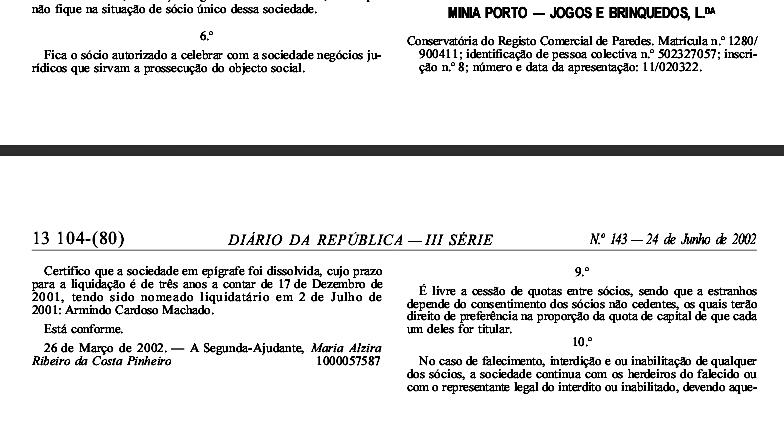
Majorette ran at a loss in 1989, and during the following years the situation didn't improve. By the end of 1992, Emile Véron and his son Alexandre had to call for meeting of creditors, and a few months after that (April 1993), the company was sold to Ideal Loisirs. After some years, in 1996, the company had to be rescued again by Triumph-Adler, that had a big plan to make Majorette competitive again. The production was centralized in Lyon, but many factories (including these in Portugal) were moved to Thailand, between the years 1999 and 2000. Was this the end of Minia Porto? It seems so. The company was wound up shorty afterwards.

Taken from Diário de República - Suplemento Sumário II Serie Parte B (24th June 2002)

 Novacar models are currently quite rare to find, although this rarity doesn't mean high prices. They are quite affordable for all those who are interested in acquiring a Portuguese "curiosity" or for Majorette "completists".

I have somewhere the yellow Ferrari 348, so I will update the article, as soon as I can photograph it. Here it is:


Hope you liked this article, it took a lot of effort to write it, since a lot of information available in other websites has been proved to be wrong.

FACTS AND FIGURES:
  • Name: FERRARI 348 GTB (Ref 101) and RENAULT ESPACE AMBULANCE (Ref 110/10)
  • Scale: 1:64 (approx.)
  • Year: 1994
  • Company: Novacar (Portugal) / Majorette (France)
  • Size: approx. 7.5 cm

Tuesday, November 27, 2012

#220 DINAMIZAÇAO “ACTION CARDS” – AVIOES A HÉLICE MILITARES (Ref. 120) (Around 1986)


This is an “exotic” quartett card deck I found during a trip to Portugal. Since I love card games, I bought this one for my collection.

They were very popular there in the last 80s, although there is very few information available on the internet about the cardmaker, or about other releases they made. If you can tell me something about them, I’d very very grateful.

The only information comes from the rules card, which says there are other decks with ships and cars available, as well as other card and board games. In the card on the left, you can see an advertisement for Nai Kei, Zig Zag and Jogo do O (which seems to be a version of Duell).


As usual in these kind of quartets, the land in which the deck has been manufactured, is widely represented on the game. Portugal has 12 planes (out of 32). There are also one plane from Mozambique (old Portuguese colony) and one from Biafra.

Also interesting is that the planes are also classified after their country of origin and also after their function (for example: transport, observation, combat…)

Some of the cards do not depict planes, but helicopters, which are a different kind of vehicle, but it doesn’t really matter, the game makes a lot of fun as it is.


FACTS AND FIGURES:
  • Name: AVIOES A HÉLICE MILITARES (Ref. 120)
  • Alternate Names: MILITARY PROPELLER-DRIVEN PLANES (English)
  • Year: Around 1986
  • Company: Dinamizaçao (Portugal)

Wednesday, March 28, 2012

#132 POLIGURI – PEUGEOT 405 TURBO 16 and MERCEDES 200 (1988)

These die-cast miniatures (~1:64) are pretty rare ones. They’re made in Portugal in the 80s (by the end of the 80s) and are very difficult to find. I bought them in an old kiosk in Portugal during a trip some years ago, together with a green trailer that I will show some other time. 
 
Die-cast models made in Portugal are relatively rare. The only brand I knew was Novacar, which I have read that it was part of the Majorette group. Another brand named Luso also built die-cast models in Portugal, but I don’t own any of their models.

Poliguri Indústria e Comércio de Brinquedos, Lda is the company we are going to talk about today. Apart from Poliguri, other names to refer to this company are "Guri" (which was also the registered trademark) and "Guricar". The company was founded in the 80s and had its base in Cacém, a city 10 kilometers west from Lisbon.
There is very few information about the company or the factory. Apparently, it was very difficult to obtain import-licenses from foreign toymakers at that time in Portugal, so a group of people thought that it would be a good idea to develop the casts and manufacture the cars in Portugal. The factory was fully automatized and had 52 employees working in two shifts.
The lifespan of the company was quite short, since it is believed, that the company closed around November 1989. In a catalogue it is mentioned that a prototype of a Lancia Integrale would be released on that date, but that never happened. Due to its short life, Poliguri only produced a handful of models, but with many variants in several colours each. Such a shame, because these cars are really quality toys, beautifully done in metal and using unique casts. I own only these three that I am presenting here.

At first look, we recognise that the Peugeot 405 could be a Siku model. The wheels are almost identical to those used by the German toymaker during the 80s. A closer look reveals that in the wheels, instead of “Siku”, we can read “Guri”. As far as we are concerned, Siku never released any Peugeot 405 Rally. Majorette did, but the casts are completely different.

A blick at the Mercedes models doesn’t reveal much, since the cast is again original. My models have a 5 or 8 radius wheels, but there are other Guri models with a three-radius wheel, that is, again, almost identical to those used by Majorette during the 80s. This Mercedes model was also released as a Taxi cab or Police versions.

These models are exceptions, since other models seems to be copied from (or maybe licensed by) Siku, for example, the Mercedes Unimog and the Mercedes 207 and 307. I do not own any of them so I cannot compare with a Siku model to confirm this supposition.

Apart from all the mentioned models, a 1:50 Fiat Uno was also made in many different colours and with different decorations. This car seems to be as well an original cast.
Information for this article was obtained from this site and this other site. Note that both sources of information could actually be the same. 

In the above mentioned links, a list of references can be found. It is also very interesting, that apart from the cars, small sets containing one car and some accessories were sold (a little bit in the “siku” style). These sets (named Guri Kits) mostly comprised a few traffic signs, plus some element like a bus stop, phone booth or gas pumps.

The cars were numbered according to those webs and catalogues 701, 702,… to (at least) 712, while the Guri Kits were numbered 700A, 700B, … to (at least) 700O


If you pay attention to the original packaging of the cars in the pictures, you’ll notice that all of them consist of the same blister and bubble (in which the car could be positioned over the card, or perpendicular to it). In all three cards, the reference is 700C. This does not match what I just said a paragraph above: my suspicion is that this could be because these models (or the models at this time) were the last produced ones, and they were simply sold as they could package them.
The cards are not printed on the back, and those red lines over gray background reminds a little bit of Majorette packages.

FACTS AND FIGURES:
  • Name: PEUGEOT 405 TURBO 16 and MERCEDES 200
  • Scale: 1:62
  • Year: 1988
  • Company: Poliguri (Portugal)
  • Size: 6 cm