Wednesday, June 15, 2011

#28 MADELMAN 2050 – DARMAN, BRAN and KARSAN (1988)

This is the last article for now dealing with this wave of the great Madelman 2050. This time we will present the C.O.T.A. Men. Check entries #27 and #28 for the rest of the story.

The C.O.T.A. men have been appointed by the ministry of defence experts to repel the attack of the Zarkons. These men have been trained in the basetron 2050, somewhere in an arctic region. There, they have learnt the most important combat disciplines, the latest technologies and, most important, the magnetron force (antigravitational power and power to unmask the invaders when they are using their “human” faces).Magnetron Power!

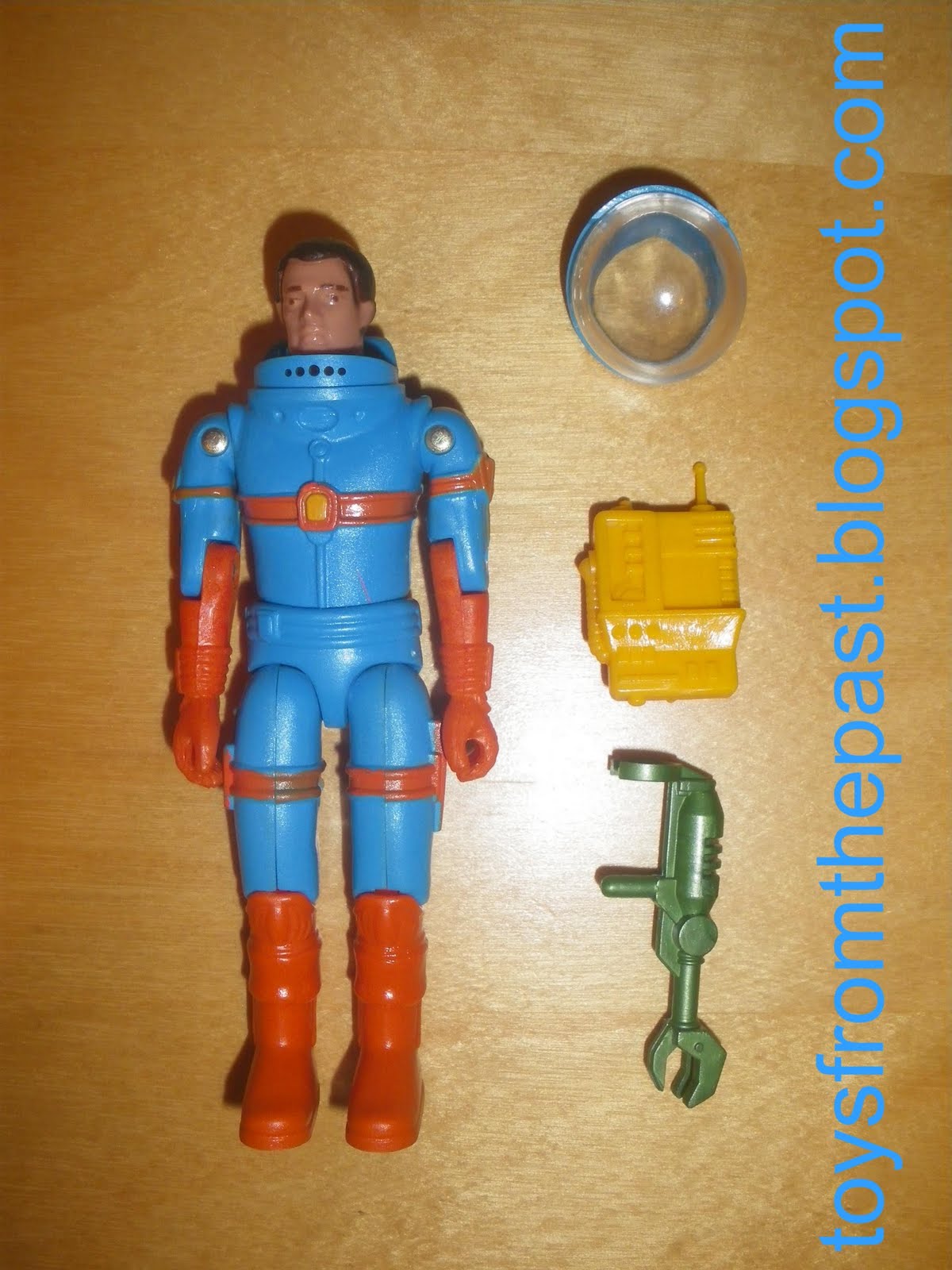
Darman (Mechanic and test pilot): Darman has probably the best cast of the four C.O.T.A. men, specially appealing is his bubble helmet and the way it fits his suit. The figure also includes a rifle and a backpack. His artwork is also the best of all four figures, since it depicts the interior of some spaceship. Through the windshield we can see some vehicle that looks like a crossing between Tarantula and Scorpion. Probably this artwork was drawn before the vehicles were actually designed, and they took a prototype as a model. Darman is the Test pilot of the NAVESCAM factory, which has engineered and built the vehicles to fight the Zarkons.

Bran (Bio-time scientific): I always thought he was the commander of the group, because of the emblem in his jacket. This figure has the most simplistic cast of all C.O.T.A. men, and Exin was probably aware of it, because they gave him the most impressive weapon: a flying backpack with two guns at the handles, that is, some kind of mini-vehicle. He is an astronomer and a scientist.

Karsan (Psico-physical instructor): Karsan has somehow the same problem than Bran. It doesn’t look like a hero, not even like a man of action. That’s probably why Exin packed this figure with a spring-loaded missile launcher, to make the figure more attractive. This part was recoloured and reused for (or maybe from) many vehicles (Batrus, Falcon, Sentinel). A helmet and a backpack complete his accessories. Psico-physics seem to be a new science which consists in the physical control of the mind. I guess it had made more sense the opposite way (psychic control of the body), but well, it’s just a toy, it’s not real.

Update: Pictures of loose figures:

DARMAN:

FACTS AND FIGURES:

  • Name: DARMAN (Ref. 1501), BRAN (Ref. 1502) & KARSAN (Ref. 1503)
  • Toy Line: Madelman 2050 (Wave 1)
  • Year: 1988
  • Company: Exin (Spain)
  • Size of the figures: 3¾’’ or 9,5 cm


Sunday, June 12, 2011

#27 MADELMAN 2050 – SERPION, REPTIS and SAURIUS (1988)


I want to continue the previous article to present the rest of the figures of the first wave of Madelman 2050. Now it’s time to take a look at the rest of the Zarkons, the stories told in the comic books, and the artworks. Next entry will present the C.O.T.A. Men. Please remember to click on the pictures to enlarge them, so you can appreciate better the details.
These creatures from planet Zarkon are the first attack unit that has been sent to planet Earth. They the best specialists on the Zarkon army.
From the comic books, we know some important facts about them. First and most important, is that their planet is cooling and becoming more and more difficult for their habitants to survive there. They are some kind of cool-blooded reptilians, and need the warmth not to die. This cooling is caused by a deviation in the orbit of the planet around a star, and their only chance to survive (as stated by their leaders, the Tadkons) is finding and colonizing another planet.
The planet they find with livable conditions is the Earth, and so the first unit arrives and hides inside the crater of a volcano. The temperature there is high, but the Zarkons can live there without problems. Under earth are also hidden their spaceships, and they have built some kind of base with a labyrinth around it.
By investigating the invaded planet, they have learn to metamorphose their faces, and look like normal humans.
These are the other three Zarkons:
Serpion (Cosmopilot, formed in the cruel Zarkians mercenary troops): This character is the counterpart to Darman, both are pilots, and both are depicted in their artworks controlling some kind of spaceship, and through the windshield we can see one of the vehicles that were sold separately. In the card from Serpion we can clearly distinguish the vehicle Falcon, that belongs to the Zarkons. The accessories included are a backpack and a rifle

Reptis (Galactic transmissions Specialist, Great Crater Dragoman): This figure in shades of green and gold included a gun and a backpack, and is the communications specialist from the Zarkons. Note the great artwork depicting Reptis with his gun, and Batrus in the background


Saurius (Space Biomechanic. Gaurdian of the underground labyrinth of OX): This figure was one of the most populars because it included a small vehicle. The vehicle is some tunnel excavator. Zarkons live underground, and so they use this vehicle to dig tunnels. Moreover, Saurius is the guardian of the maze of OX, which probably consists of all these tunnels he has dug.
FACTS AND FIGURES:
  • Name: SERPION (Ref. 1601), REPTIS (Ref. 1602) & SAURIUS (Ref. 1603)
  • Toy Line: Madelman 2050 (Wave 1)
  • Year: 1988
  • Company: Exin (Spain)
  • Size of the figures: 3¾’’ or 9,5 cm

Wednesday, June 8, 2011

#26 MADELMAN 2050 – ZAN and LAGARD (1988)


At the end of the eighties, many figure collections in 3¾’’ size were made and sold everywhere. The reason for that was obviously the great success that G.I.Joe became those years with their ARAH (A Real American Hero) series. In Spain, (one of) the company (companies) that tried to repeat the success of Hasbro was Exin. Exin had bought the rights of Madelman when Madel went in bankruptcy in 1983. The Catalonian company planned the figures as a sci-fi, futuristic heroes (Hombres C.O.T.A. – C.O.T.A. Men) in war against some extraterrestrials Earth invaders (Zarkons)
The figures were made with high quality, with great moulds and paints, but their most remarkable characteristics were their special features: the villains have a double face (reptilian and human). The reptilian identity is revealed when one of the heroes stands in front of one villain, and this is possible because of magnets hidden in the chests of the figures. Both the C.O.T.A. men and the Zarkons had magnets at their feet, which allowed them to stand upside-down in the Basetron 2050, which was built with some metal parts.

Enlarge to see the special features at the right side of the backcard, and the catalogue (figures and vehicles) of the first wave at the left side.

The plastic casts of the figures are absolutely great. Their only flaw could be the slightly thin arms. Considering that the series had a lifespan of only one year, the variety of casts is absolutely great: all 8 figures are different and have different weapons! This is not true for the vehicles, which share some common parts with other vehicles. The second series was planned with a few figures made of new casts, but those were actually never produced massively. The only figures released from this 2nd series were repaints of two figures from series 1 (apart from the Clonstar pilots).

The figures were more fragile than their American counterparts, and their arms broke sometimes during the play. Their waist articulation is very resistant (no O-ring), and we have to highlight the magnet feature, rarely seen before in an action figure collection.

The figures were not a great success at the time. Maybe they came 1 or 2 years too late, or maybe the thematic was too different to G.I.Joe: ARAH. Hasbro´s collection was very popular in 1988 in Spain and, although Exin’s line was serious and very well done, it had very few chances to success. We recognise the great bravery of the spanish company trying to compete with a quality product, instead of just copying the Hasbro soldiers like other companies did (for instance Unifighters –Galoob- or the Corps! –Lanard-). At their market release, the figures were priced slightly cheaper than G.I.Joes (around 600 pesetas instead of 800), but shortly afterwards, it wasn’t strange to see 2x1 offers in toy shops.

Comic book included

Exin even created several comic books in which the history of the Madelman 2050s was explained. These comics remind quite a lot to those from Masters of the Universe. 4 of them were printed. All the figures in this first wave included the same comic book, that’s the one with the title: “La Invasión de los Zarkons” (Zarkons’ Invasion). Curiously, the comic is copyrighted earlier than the figures (December 1987).

The first series (1988) consists of 8 figures, the fortress Basetron 2000 and several vehicles. The second series (1989) was partly manufactured because of the early cancellation of the series. Only a few of the figures and vehicles displayed were built for the market, and they are very difficult to find. The rest were probably just prototypes.

The first two figures I wanted to show are the commanders of each faction: Zan and Lagard (Reference Numbers 1500 and 1600). Zan is described in the box as: “Commander and Pilot of the C.O.T.A. Men”, while Lagard is “Commander of planet Zarkon’s first attack unit”. They include the above mentioned comic book, and their box has an amazing artwork that can be counted among my favourite artworks for toys. The card’s halves were glued together, but with the years, the glue dried, and they do not stand together anymore. Because of this, the comic book is sometimes lost.

Zan also includes the little robot named "Mascota" (in english "Pet" or "Mascot"). Curious about this figure, is that its head is inspired by the Madelman figure from 1977 known as "Suárez" (that received its name because of its resemblance to spanish president Adolfo Suárez, who won the first democratic elections that same year). Here's a comparison among them.

Comparison between President Suárez, Madelman Suárez '77 and Madelman 2050 Zan '88. Original pic courtesy of Juan (Madelman Blog Show), modified by myself.

Update: M2050 Comic Book #1 "La Invasión de los Zarkons"


NOTE: This article will be continued soon, with more figures from the first series, as well as many other interesting facts.

FACTS and FIGURES:
  • Name: ZAN (Ref. 1500) & LAGARD (Ref. 1600)
  • Toy Line: Madelman 2050 (Wave 1)
  • Year: 1988
  • Company: Exin (Spain)
  • Size of the figures: 3¾’’ or 9,5 cm

Sunday, June 5, 2011

#25 KIDCO – BURNIN’ KEY CAR KNIGHT 2000 (1982)


Kidco is somehow a very rare toy company. It only existed during a few years, and their models are difficult to find. These are not specially detailed, or well-made; I just guess the company didn’t have the time to improve its fabrication methods, before it...changed its name.

In the world of the scale cars, it sometimes happens, that one brand is interconnected with many others. This won’t be an exception. Kidco was founded in 1977 in Besenville, Illinois, and it was nothing else than a marketing arrangement to sell the toys from Universal Toys in America. This other company was producing scale cars in Macau and Hong Kong, under the management of David Yeh. The models made and marked with the Kidco brand first appeared in 1979 and disappeared around 1983-84. 

The end of the company came, when David Yeh and his group (Universal Group) acquired Lesney and Matchbox in 1982, after the British company went bankruptcy and into receivership (except the yesteryear line, which was acquired by Lledo). At this point, Universal shifted from Kidco to Matchbox (now Matchbox International), and this is the reason why since the mid-80s, many Matchbox models were made in Macau, and later in China. And the reason why Kidco as a brand disappeared.

Matchbox would remain in the hands of Universal Group, until 1992, when the brand was sold to Tyco Toys.

Kidco made this wonderful reproduction of the “Knight Rider” in 1982, with metal base, but plastic bodywork. Level detail is low. Windshields are all black to hide the spring mechanism inside, which allows the car to be “shot” using a key. The key was obviously provided with each car, and the keyring was always decorated with the name of the car, so there’s a different keyring for each different model.

During these years Kidco produced for this “Burnin’ Key Car” series several toy cars that appeared in popular TV shows, like the A-Team van or at least two cars from Magnum P.I.. This car is also showed in the review.


At the base of the black car, we can still read a copyright symbol with the words Universal Studios 1984, what means, that the product was officially licensed. It surprises me a bit, that if they had the license, they used “Knight 2000” instead of “Knight Rider”, but we’ll probably never know. The Magnum Ferrari 308 GTS has the T.M. after the name of the car: Magnum p.i. T.M., so it is also a licensed product, but this time from 1980.

In the normal series, these cars were also reproduced, along with cars seen in movies like Cannonball Run or TV-series like Emergency. The “Demolition Set” was also released in 1983, and it was a playset in which the cars could be shot against several obstacles and ramps.

Several years later, these cars were sold under the Matchbox brand. The cars were exactly the same, as it can be seen in this catalogue from 1987. Note that the two cars I have presented are not in the list, probably because at that time, the TV series "Knight Rider" and "Magnum p.i." were not on air anymore, and it wasn't commercially interesting to release them. The series "Demolition Cars" were also available a few years earlier under the Kidco brand.

Page from Matchbox Catalogue from 1987. Scan found in MatchboxPeru.com.

Special thanks to Speedy who put me on the track to the Matchbox series.

UPDATE: I found the same model made by Matchbox and comparing their casts, I have observed subtle differences between them (wheels, base, side spoilers). Here a few pictures:


UPDATE2 (Nov/2019): Here is a curious launcher by Kidco that is decorated with the same colours and stickers of the Knight 2000. I think it must belong to another model, since this model has no need to be launched, as it comes with the "firing-key" mechanism inside. Any ideas where does this come from?


UPDATE (Jun/2023): This is the Matchbox model of the Pontiac Firefird, with no reference to the Knight 2000. Instead of this text, the toy displays red and blue sports stripes on both sides and over the bonnet.


FACTS AND FIGURES
  • Name: Knight 2000 (Pontiac Firebird) and Magnum p.i. (Ferrari 308 GTS)
  • Scale: 1:64 approx
  • Year: 1982 and 1980
  • Company: Kidco (U.S.A.) and Matchbox (Great Britain)
  • Size: approx. 3’’ or 7 cm

Thursday, June 2, 2011

#24 MASTERS OF THE UNIVERSE – MEKANECK and JITSU (Refs. 4919 and 4924) (1984)

My first and only review to date dealing with the Masters of the Universe is #12 (Castle Grayskull), and according to blogger stats, is one of the most successful ones in TFTP. I wanted to write another article about this wonderful series of figures, one of my favourite lines of all times. This time I’ll talk about two figures from the third wave, released in 1984: Mekaneck and Jitsu.
The third wave was somehow a transition between the first two series and the rest of the collection. Wave 1 figures had only the “waist twisting” action, figures in the second one, too (except Ran-Man, which was made of a completely different way, Man-E-Faces, with his changing faces, and Trap-Jaw, who had movable jaws. These features are nothing compared with what it is to come from wave 4 on. Both figures that I present today have great features:
-Mekaneck is the “human periscope” of the heroic warriors, and can extend his neck to have a better point of view. His glasses are chromed and look like mirrors. Mekaneck came with a yellow club and a red removable two-part armor.

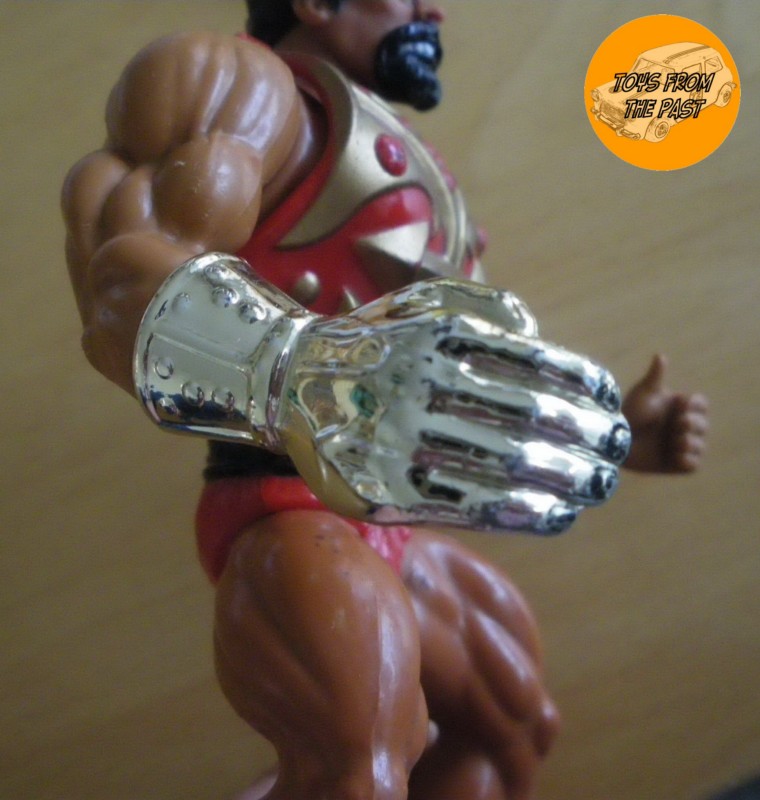
-Jitsu is the "evil master of martial arts", and his special movement is a punch with his right hand. His hand is golden, although with the time, it tends to loose its glitter. The figure came with a orange sword and a red removable two-part armor.

With the third wave, the popularity of the series kept growing, reaching the top during the series 4, with the new, third-party, “evil Horde”, and new and exciting features. The popularity of series 4 (and its sales), were so high, that Mattel probably gave a blank check to the designers to do what they wanted from wave 5 on. Only this way can be understood, that Masters of the Universe released in 1985 the largest playset in this collection (and probably one of the 5 largest action figure's playsets of all times), named Eternia.
Going back to the figures, they are 5½’’ tall (14 cms), and almost all of them, have this characteristic form, with very muscled torso, arms, and legs. There are different moulds for arms, chests, and legs, but they all look very similar. If you compare the pics, these two figures share exactly the same mould, except for the head... and well, Mekaneck’s torso has been modified a little, due to his action feature.
The colours of the figures are varied, although “human” or “human-similar” characters usually have skin-color bodies. Jitsu and Mekaneck are humans. Mekaneck seem to be wearing some kind of tigh dress, see his hands and face.


Detail photos of the Makaneck’s neck and Jitsu’s fist.
FACTS and FIGURES:
  • Name: MEKANECK (Ref. 4919) and JITSU (Ref. 4924)
  • Toy Line: Masters of the Universe (Wave 3)
  • Year: 1984
  • Company: Mattel (U.S.A.)
  • Size of the figures: 5½’’ or 14 cm