Friday, April 10, 2020

#947 POWER COMMANDOS - FIGURES FROM WAVE 1 (1992)


I have known this series for a long time because it is one of the most thoroughly reviewed in the "bootleg" list of yojoe.com. I considered I knew a lot about Hasbro´s G.I.Joe: ARAH bootlegs, but I had not seen these anywhere else.

In ten years I only saw them very few times on eBay, and I got to buy two of them loose without accesories.

Fortunately, around three years ago, many lots of blister packs were sold by a Mexican seller, and I got a complete set for a relatively small amount of money. I didn´t ask him, but it looks like he found old stock somewhere and put all that for sale, either the figures in blister packs or loose (probably because some cards were too damaged for collectors). I recall that the description also stated that some blisters might present damage of some kind, so receiving the blister cards in perfect shape was a nice surprise.
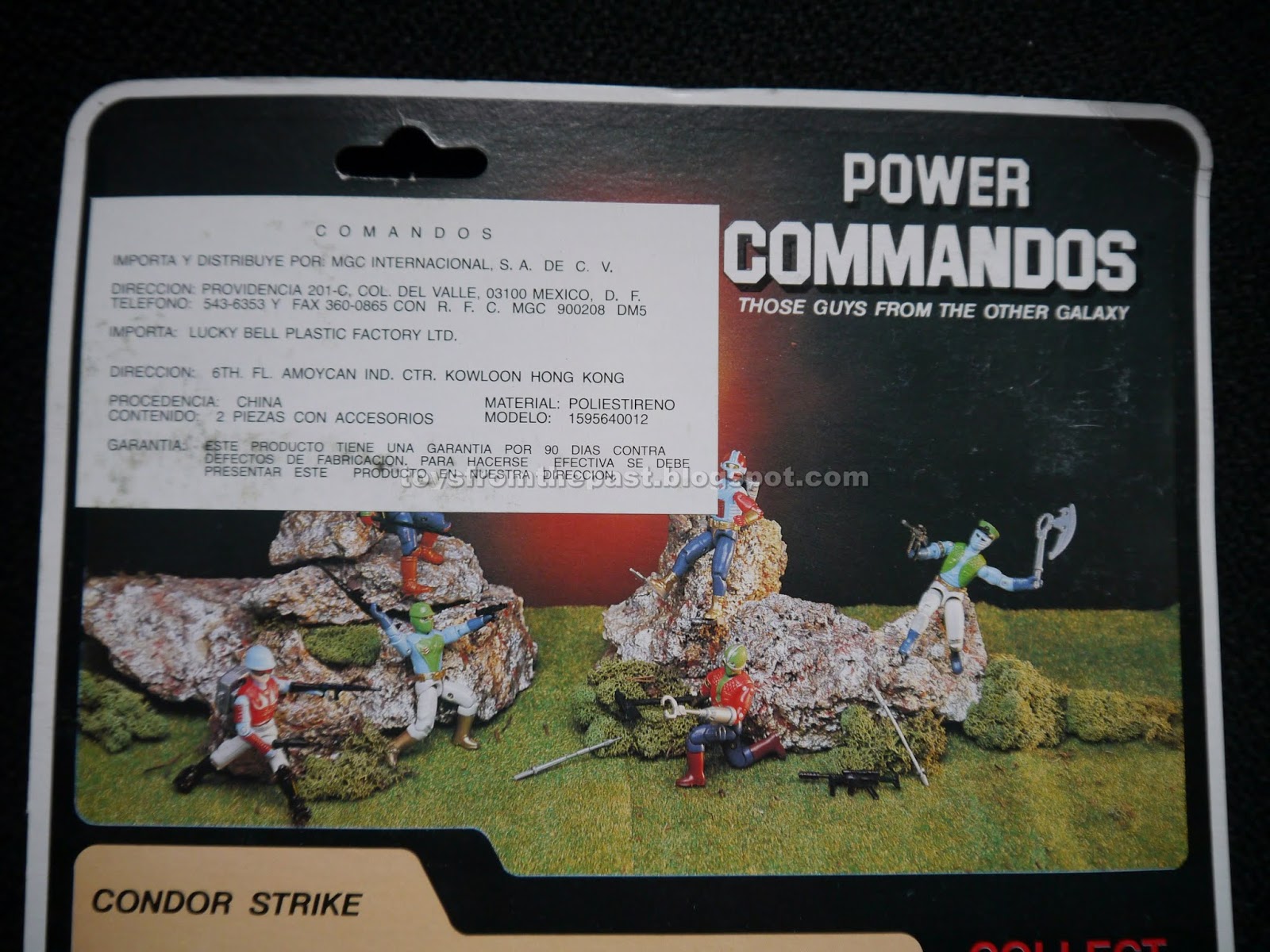
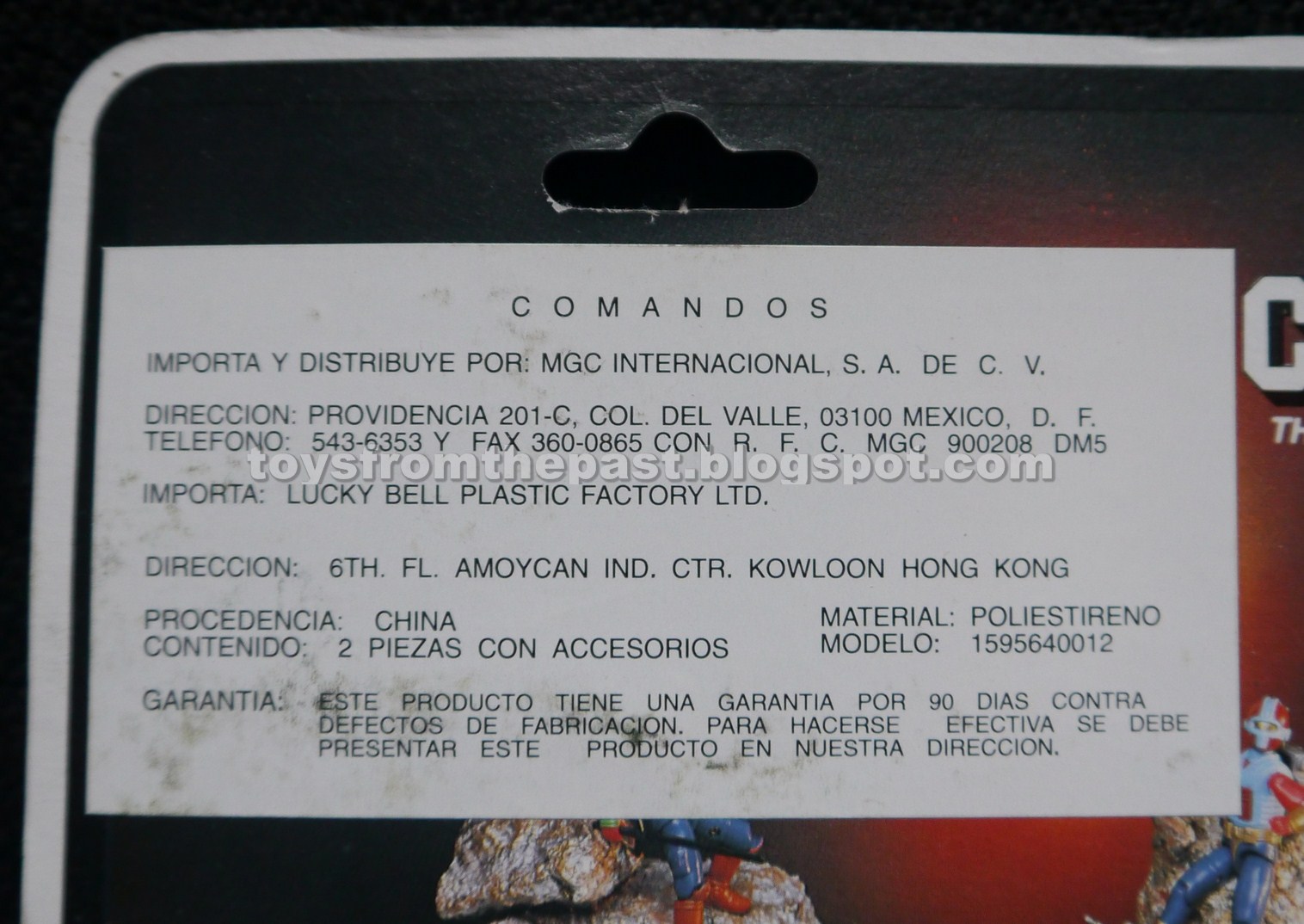
Information about Lucky Bell and the Mexican importer
Copyright Notice

The Power Commandos by Lucky Bell are interesting for a series of reasons. One reason is that some body parts are very similar to others from original G.I.Joe and Cobra characters (for example some arms are just like 1986´s Vipers). Another one is that some characters vaguely remind of other from the Hasbro´s toyline, although the heads are all new, original sculpts, and third, because the weapons are quite imaginative and some are also bootlegged from Hasbro.

Other positive points for the line is the quality and durability of the figures and also the nice packaging art, also inspired by Hasbro. I like that some details of the figures are painted gold and also that the accesories come in different colours, but I dislike the colour combinations of these first 6 figures, all trousers are either light brown or blue, all torsos are either blue or red and the details are also blue, red or green, so all six figures look somewhat similar to each other.

This small flaw continued in a second series of figures, which are much rarer, but was corrected in the third wave which is ultra-rare and from which only a few pics have been seen so far. We will come to this later.

Another flaw is that in six figures we find only three different models of each body part: three torsos, three waists, three legs and three arms, all doubled, but six different heads, some of them very cool! This is not rare in G.I.Joe bootlegs, see for example The Corps or Kaido.

The character´s names are quite good, as we will see next, and they came with a filecard each with some bio-facts. Unfortunately they are written in poor English and the texts are rather simple and plain, not to mention the tag "Those guys from another galaxy", that actually reminds more of Masters of the Universe than G.I.Joe. The birthplaces of each character is not a real one (for example: "South of Arenia")

The figures were sold in couples, being one of the characters always a Power hero and the second one an evil villain. Note that the file cards have different colours and one is marked "Power" while the other is marked "Terror". Since these words are placed below the picture (that's where the affiliation of  G.I.Joe characters was indicated in the filecard), I would suggest the the good guys are the Power Commandos, and they fight an evil corporation or entity called Terror. Why not?


There were three blisters available:

1. Condor Strike
2. Red Raven

3. X-Ray Eye
4. Submarine

5. Mummy Mask
6. Metal Hawk

The blisters originally had its own artwork depicting both characters in action.

BLISTER 1: CONDOR STRIKE + RED RAVEN


BLISTER 2: X-RAY EYE + SUBMARINE


BLISTER 3: MUMMY MASK + METAL HAWK


Wave two figures are similar in colours but are made out of different parts/new sculpts, also inspired by G.I.Joe. The blister back showed all 12 figures in action, but the rest of the package is very similar. Of course the artwork was new and represented the new characters.

Wave 3 figures were sold individually and the package had brighter colours, maybe following the trend started by the G.I.Joes from 1992, 1993 and 1994. The text Power Commandos is written in yellow, the card frame is bright pink and the figures themselves are mostly pink, bright green and purple... this time the artwork is recycled from series 2 and the figures are also made out of parts already used in waves 1 and 2. Maybe I get these figures someday so I can take pictures and show them here.

FACTS AND FIGURES:
  • Name: CONDOR STRIKE, RED RAVEN, X-RAY EYE, SUBMARINE, MUMMY MASK and METAL HAWK
  • Toy Line: Power Commandos (Wave 1)
  • Year: 1992
  • Company: Lucky Bell (Hong-Kong)
  • Size of the figures: Around 9.5 cm

Friday, March 20, 2020

#946 PILEN – MONZA G.T. (Ref. M-301) (1973)


This is a great model by Pilen that resembles quite a lot the Joal version of the same car. I presented the Joal version a long time ago in this blog (see #247)

Remember that Joal and Pilen were both based in Ibi, which is a small town, where also Guisval, Mira and other famous die-cast brands were based. The companies had family relations among them and it was not rare that casts went from one factory to the other.

The differences are clear. This model was simplified in order to produce it cheaper and does not have an opening bonnet. Just the cockpit can be opened. I would say, otherwise Pilen and Joal models are identical.


The cast debuted as Pilen in 1971 is a red and white version. The Joal version was two years older. In the 1973 catalogue it is the first time that this model is pictured, although there were another one with chrome finish. This last one does not appear in the catalogues, but the chromed versions are common for many Pilen models, so this one is no exception.

I like the decoration, which is rather simple. It carries race number 69, the words Escudería Pilen and two crossed flags.

This model is boxed, so we can observe that it came in a jewel box with yellow base, in which a sticker is placed with the reference number and the name of the car. I think I have shown these kind of boxes by Pilen before.


FACTS AND FIGURES:
  • Name: MONZA G.T. (Ref. M-301) 
  • Scale: 1:43
  • Year: 1973
  • Company: Pilen (Spain)
  • Size: approx. 9 cm

Friday, March 13, 2020

#945 SIKU – OPEL SENATOR and MERCEDES-BENZ 500 SE (Ref. 1040 and 1042) (1981 and 1982)


These two cars are in a rather good condition, but present some scratches and paint losses. Still they are excellent miniatures quite rare to find today, as the approach their 40th anniversary.


Both are made in 1:55 scale as it is usual in Siku’s Super Series. Made in massive metal are bigger and heavier than most Matchbox models or equivalent in the 3 inches size category. The represent large cars, among the largest available back in the day.


Opel Senator was launched in 1981 and discontinued in 1988. My model is metallic red. Other colours include orange, and much rarer light blue, yellow and tourquoise.


Mercedes-Benz 500 SE was release one year later, in 1982 and discontinued in 1990. My car is metallic blue, but it seems to be available also in black and metallic red, but these are much rarer than the blue one here.

Great models!


FACTS AND FIGURES:
  • Name: OPEL SENATOR and MERCEDES-BENZ 500 SE (Ref. 1040 and 1042)
  • Scale: 1:55
  • Year: 1981 and 1982
  • Company: Siku (West Germany)
  • Size: approx. 8 cm

Friday, February 21, 2020

#944 GOBOTS – VAMP amd SCORP (MRD-101, MRD-103) (1984)


The Go-Bot line with vehicles, called Machine-Robo, had more than 50 references, including every type of vehicle. This one is the most famous line that everybody remembers, but the Go-Bots also had an alternative line of “monsters”, called Devil Invader Series, that had references with the letters MRD (RMD in Europe), instead of just MR (or RM), I guess, the “D” comes from Devil.

I have just two robots belonging to this series, one Batmobile-alike vehicle that trasnforms into a vampire robot, and a Robot-Scorpion. Both are very cool and imaginative, they do surprise much more than the vehicles line.


All MRD references seem to be evil characters, unlike the MR references, who belong to one of two factions: “Friendly Robots” or “Enemy Robots”, although this was not always like this… at the beginning, there was no reference to the filiation of the robots, if any at all, but in later catalogues, there are some that show the robots in two separate groups. Maybe this was a consequence of the animated series (1984-85) in which there were good a bad go-bots that fought against each other.

I just discovered a great website with all Go-Bot toys and I think it deserves being promoted so it stays the reference site on the Internet about this Popy/Bandai/Tonka toyline. Pelase visit: http://www.the-liberator.net/


It has been a long time since the last entry dedicated to these nice transforming robots, but I guess we won’t have to wait so much for the next one… I have some more robots awaiting in the line to be presented.

FACTS AND FIGURES:
  • Name: VAMP amd SCORP (MRD-101, MRD-103)
  • Alternate Names: CASMODON, ZARIOS (Machine Robo names/ Japan)
  • Toy Line: Go-Bots (Series 2)
  • Year: 1984
  • Company: Popy/ Bandai (Japan) / Tonka (U.S.A.)
  • Size of the figures: Around 8 cm

Friday, February 7, 2020

#943 LONE STAR - IMPY SERIES – TIMBER TRUCK (Ref.No.60), PETROL TANKER (Ref.No.61) and LONG PETROL TANKER (Ref.No.182) (1976)


Lone Star had a series of rather simply casted trucks sold under the Impy series. I show three in this entry, a long tanker, a short tanker and a short truck with a flat bed platform (that originally carried short sticks of wood).

The models came in boxes with windows that specified a copyright from 1976. The exact text on the boxes were: “Made by Lone Star Products Ltd. Welham Green Herts AL97NT England”, plus “© Lone Star 1976”.

There are two lists on the back of the smaller boxes, the first one is for Trucks and have references 50 to 61. The second one is for cars, with references between 71 and 82.


The long trucks came in long boxes labelled as IMPY MAJORS and are also marked on the base. They seem to have references in the 18x range, but also 128x or 129x.


The line of trucks (both long and short) was also known as COMMERCIALS.

The models are simplified representations of generic trucks: there is a truck with “flat” front and another one with long front (“american style”), each of them combining several kind of loads: tipper, tanker, mixer… The paintwork also seem to be applied randomly, but using always basic bright colours, and all in all, looks like a budget alternative to the “other” Lone Star trucks from the 60s and the 50s. Probably they were intended to compete against the cheap die-cast models from Hong-Kong, which during the mid-70s were already very common in the United Kingdom.


These models are quite rare (at least outside the UK, where they might be more common), but still affordable and easy to find (even boxed or mint), I guess it is just they are not good enough for many collectors: they are objectively not nicely done and they do not represent actual truck models. In comparison with the cars mentioned above, the price difference of used models and their scarcity is remarkable.

UPDATE 1 (Dec/2021) Another truck (this time it is a dumper) courtesy of Steven!


UPDATE 2 (NOV/2022)

Here comes another Flatbed truck, but with a different cabin and different colours. I think the colours were applied randomly.


FACTS AND FIGURES:

  • Name: TIMBER TRUCK (Ref.No.60), PETROL TANKER (Ref.No.61) and LONG PETROL TANKER (Ref.No.182)
  • Scale: Around 1:100
  • Year: 1976
  • Company: Lone Star (Great Britain)
  • Size: approx. 7 cm

Sunday, January 19, 2020

#942 MATCHBOX - JEEP CJ6 "MADE IN HUNGARY" (1987)


MATCHBOX "MADE IN HUNGARY" MODELS

Some Matchbox Superfast variants are gaining now some popularity and collectors started looking for them. among them are the Bulgarian and Hungarian models, which were made later than the British equivalents, mostly during the late 80s. The models from Bulgaria were manufactured between 1983 and 2005 and the Hungarian models were manufactured only in 1987 and 1988.

Unfortunately there is not much information about this topic out there. Just the WIkipedia has a couple of lines telling that dies and tooling were licensed to groups in Hungary and Bulgaria to try to gain a foothold in the Communist bloc countries...

This time I´ll focus only in the Hungarian models, although many things written here are also suitable for the Bulgarian models.


The first thing that attracts your attention is the uncommon color of the car. The British models usually had 2 versions of each reference (maybe more if it was manufactured during a long period of time, part of a bigger set with trailer…), but in Hungary, the colors were applied randomly. Each model was available in many colors mostly "basic" (mostly mixtures of two primary colors, black or white at 50% each) ones: blue, light blue, green, red, maroon, green, dark green, gold, yellow and light yellow…

The wheels could also vary, so the color of the hubcaps, as well as additional or removable parts (in this case, the canopy, could be black or brown), interiors… all the usual staff. Some come with tampographies which are not the “official” ones, but they are typically simple and mostly based in one or two colours.

The Matchbox variant page from Christian Falkensteiner registers more than 200 variants on this particular Hungarian model, while the Bristish superfast Nr. 53 only has 31 registered variants (plus boxes). Hell on Earth. I won’t be collecting these, nor the Bulgarian models, it’s OK if I get one of each. This is my Hungarian model, now I need one Bulgarian one.

At the time it was a cheap product, but considering the years in which they were made, they are much better than the Chinese Super G.T.s Why the production in Hungary was cancelled after only two years is something I’d like to know. Does it really have to do with the Communist bloc, as stated in the Wikipedia? The Communist regime fell exactly during that same year (1988) and led to the Third Republic one year later (1989), so this could be an explanation... Seeing the revolts coming, and the end of the Communist era made Matchbox reconsider the production in this country.

The production in Bulgaria lasted much longer… I would say producing in Bulgaria was even cheaper than producing in Hungary, considering only GDP numbers. Anyone knows what happened with these "Made in Hungary" models and the markets were they were being distributed? Were they replaced by Bulgarian or Macao models? I mention this because the production in these two countries continued over 1989 for many years more.


FACTS and FIGURES:

  • Name: JEEP CJ6
  • Scale: Around 1:64
  • Year: 1987
  • Company: Matchbox (United Kingdom/ Hungary)
  • Size: approx. 7 cm