Friday, September 27, 2013

#330 MICRO MACHINES – CAR WASH CITY (1989)


It has been a while since I showed a “real” Micro Machine in this blog, so today I’ll go for this nice playset from 1989: the Car Wash City.

The toy-line was launched in 1987, since it worked well, the assortment was widely improved in 1988, and that same year, Galoob realized they had “discovered” a gold mine.

In 1988 Galoob offered for the first time the small “Travel City Playsets”, as well as two medium playsets (also available in 1987, “City Service Center” and “Airport/Marina”) and the big “Supercity Toolbox”. With that, Galoob covered the whole size and price range for playsets. All those playsets were self-contained.

In 1989, and as a result of that, the playset range explodes including around 10 new types of toys, including a slot-car racetrack, and the three types from the year before.


Famosa Comercial S.A. - Onil (Alicante)

The “Car Wash City” belongs to the “Action Playsets”, and was the only reference together with the “Service City”, although from 1990 on, similar playsets were released.

This new playset has a very low plastic base, so it is not 100% compatible with the “Travel City Playsets”, so they had to include a special ramp in the box. The “Super City Toolbox”, however, is compatible with both high and low base types. Also remarkable is that this set is not self-contained, so it is not intended to be transported often, or to play outdoors.

The box is the Spanish version from Famosa. The front of the box shows the playset with many cars on it, although the box includes no vehicles. The back of the box show again the same picture over white background, and the special “action” features are highlighted: parking tower, elevator, twisting restaurant plus the different parts of the car wash tunnel.


The toy is mint on box, and I never opened the bags inside. The contents are all as I bought them. What surprised me most are the instructions, which are a photocopy. I’m not sure if they’re original, or if maybe they were replaced by the toy store owner sometime. I bought it in a toy store, so theoretically I’m the first owner of this set.

I’m sorry I cannot offer better pictures of the set, but with the box and the parts, you can make yourself an idea of what this car wash tunnel is.

Contents of the box with protective inlay

Bagged contents

Unapplied sticker sheet

FACTS and FIGURES:
  • Name: CAR WASH CITY PLAYSET
  • Toy Line: Micro Machines
  • Year: 1989
  • Company: Galoob (U.S.A.)
  • Size of the vehicles: Approx. 1,5’’ or 2 cm
  • Size of the playset: Approx. 20 cm long 

Tuesday, September 24, 2013

#329 VARIOUS BRITISH DIE-CAST MAGAZINES


During my holidays last month I visited Ireland. It was a great experience and we enjoyed the trip quite a lot. I had in mind visiting some big bookstores and maybe find some good books about toys in English language. I thought it would be easy to find something about Matchbox, Corgi or Dinky, but it wasn´t. It was in the newsagents' where I found some interesting publications. First I bought “Model Collector” and afterwards “Die-Cast Collector” (it came together with the “Collectors Gazette”), so now I have read and enjoyed 3 different publications on toys (especially on die-cast toys).

They include a nice mixture of articles dealing with old models and new releases. Since I am only interested in vintage toys, I would have preferred magazines dealing exclusively with them, but that was a good start. I read first “Model Collector” and I enjoyed quite a lot those articles about the Renault Estafette, Dinky Juniors or Corgi’s Hillman IMP 50. There was a lot of information on new releases from IXO, Oxford Die-Cast, Corgi, EFE, HotWheels!, NEX models, and many other companies in a variety of scales ranging from 1:8 to 1:87 (H0) with a notable exception: 1:64. It seems that in England (or may I say Europe in general?) the 1:64 scale is completely out of scope for serious collectors, who mostly disregard these as toys.

The second magazine Die-Cast collector is also a very good publication. It also includes lots of articles dealing with "old" die-cast models. So I cannot really decide which magazine is better than the other one. The articles featured in this number deal, among other topics, with Massey Harris harvesters, French die-cast catalogues, Britain’s motorbikes, or Corgi’s Ghia L 6.4 with Chrysler Engine.

The “Collectors Gazette” is maybe more interesting than the previous two publications, since it deals not only with car miniatures, but also with action figures, tin toys and other toys. Unfortunately it is much shorter, and the paper quality is worse.

Conclusion: three magazines I would buy if I lived in Britain or Ireland, but it comes to a real lot of Money overseas. I wish they offered the ebook edition only at lower prices, although it is comprehensible that they do not.

Now, some thoughts on these magazines:

It is amazing how many fairs and events are organised in England for collectors. I wish there were some like those here where I live, but they are very rare, and even rarer those dedicated exclusively to toys. Collecting in England is definitely on a higher level than in the rest of the world.

Throughout the articles there is always a lot of information on prices, which is good if you are looking for some of those rare models, but for me, prices are out of focus. Price guides are rarely accurate, since there are many factors to take into account when buying anything... it says nothing to me, that model X from manufacturer Y sold for 1000 pounds last month, 500 over its higher estimation. I guess it brings (kind of) calm to many collectors out there thinking they own a very valuable collection, but I would say it is just an anecdote. And the doubt will always remain, would they also publish that in case the auction ended much below the estimation?

The only thing that really bothered me are the hundreds of advertisements willing to buy your collection, promising to pay you the best prices, collection in-person nationwide and so on... surely you know what I am talking about. It is almost violent reading those ads. I understand that the magazines main income is due to these ads, but the shops/resellers should be less aggressive and more polite with these aspects. This types are present in all of them.

Nevertheless, it was nice to read about "new" models since it is always good to learn things, and they display very nicely in those pages, but I wouldn’t consider acquiring any of the models shown there. A different thing is that I get one model for free!

I found this Austin Paralanian by Oxford Die-cast and took it with me. It is an astounding model in 1:76 scale, with an amazing detail level for its size. Really well done! In shops, I could see more of them, and they were all great. Most were available for around 5 Euros.


FACTS AND FIGURES:
  • Name: AUSTIN PARALANIAN (Ref 76JA005)
  • Scale: 1:76
  • Year: 2011
  • Company: Oxford Diecast (Great Britain)
  • Size: approx. 5,5 cm

Sunday, September 22, 2013

#328 HOT WHEELS! – VOLKSWAGEN GOLF CABRIOLET (Ref. 6909) (Around 1982)

ITALIAN HOT WHEELS!

The relation between HotWheels! and Italy begins in 1969. In that year, Mattel purchases Mebetoys, a company with high quality standards especialized in 1:43 scale models. Mebetoys was owned back then by the Besana family, who were accepted in the new company to cooperate with the new team. Unfortunately, something went wrong, because after only four months, they were rejected.
According to Arumi, Mattel included in the purchase contract the clause that after the purchase was made effective, the Besana family could not start any business dealing with die-cast toys in general and car models in particular within the following 5 years.


During that time, HotWheels! models are marked both with the Mattel and the Mebetoys logo. Many of those models were Mebetoys earlier creations, in which the chassis was modified to include both logos.

There were 40 references that year of 1969, all Mebetoys designs, based mostly in Italian and European cars, never seen in the US before. These cars wouldn’t sell anywhere but in Europe, so it was really surprising, that new Mattel models (for the following years) were more European cars (Volkswagen, Citroën, Fiat…) Here’s a nice catalogue scan from the year 1981, in which this last statement can be proved. Other “new” references were not really new models, but new versions of old Mebetoys’.


After that, Hotwheels launched the famous “Gran Toros” series, from which the reader can find a lot of information here.

The Mebetoys logo was removed from all chassis, and the name discontinued around the years 1980 or 1981. In 1984 all Italian factories ceased their production and closed. This Volkswagen was therefore made between 1980 and 1984, since there is no Mebetoys logo on the base and it is still “made in Italy”. I couldn’t find the exact date, but the reference number 6909. Maybe anyone can help me here.


The Gran Toros had great quality, many practicable parts, metallic axles with metallic hubs, and many many other features, but this car was released later, in another 1:43 series, which is clearly much cheaper and simpler. Starting with the chassis in white plastic, which is at the same time the axles. Wheels are "inserted" in them. As a result of many hours of play, the plastic axles are a bit bent, maybe you can see that in the photographs. The car has no practicable parts, and it has the sticker at only one side.

The car was available in a windowed box, so the sticker on the other side could not be seen without taking the car out of the box. The missing sticker was probably never applied, since it was provided in a separate sticker's sheet, to save in manufacturing costs (the same thing that happened to this model by Polistil).


FACTS AND FIGURES:
  • Name: VOLKSWAGEN GOLF CABRIOLET (Ref 6909)
  • Scale: 1:43
  • Year: Around 1982
  • Company: Hot Wheels! - Mattel (U.S.A.) / Mebetoys (Italy)
  • Size: approx. 9 cm

Thursday, September 19, 2013

#327 SUNGOLD – SPECIAL FORCE: A TEAM OF MODERN ARMY (Around 1990)


These are some G.I.Joe: ARAH bootlegs I have collected during the last 20 or 25 years. The original casts were made by a company called Sungold, which is mostly known for its Masters of the Universe bootlegs, “Galaxy Warriors”. It is difficult to find reliable facts about Sungold, so I will leave a “History of Sungold” entry for a future occasion.

This time I will just show some of these figures, and will tell what I know about them.


Two blue Dial-Tone figures made by Sungold. Note the different paint schemes.
The series comprises only 4 figures, based on (or directly copied from) 4 famous characters in the Hasbro toyline: Beachhead, Leatherneck, Dial-Tone and Alpine. These four characters appear in the blister card.
All figures are made of soft plastic, and have moving arms. They came originally with a few weapons which were also Hasbro’s knock-offs.

The first figure I ever had from the “Special Series” line, was “Beachhead” in green colour. I can remember I bought it around 1992, in the “100 pesetas” shop that had opened in my town just a few days before. It came with a few accessories that I still keep, but the figure lost one arm while playing. Since it was not very easy to repair it and it costed only 100 pesetas (0,60 Eur), it probably ended up its days in the trash bin.

Blister Type "1" by Sungold (pic: Darth Wince from froums.rebelscum.com)

Since then, I have found a few more figures. The next one in my timeline is the blue Dial-Tone figure, shown in the picture with the remaining weapons from my first Beachhead (a “Mainframe backpack” with a strap is missing, but was originally included, like in this pack above).


The first packages (type "1") included a few accessories. Later ones (type "2"), came with only one gun or rifle in a separate blister.

Blister Type "2" by Sungold (Pic: Kreatobergas from eBay)

Just two or three years ago, I found this new packaged figure (Alpine) in a flea market, and I bought it without thinking it twice. This new package (we will call it type "3") is much worse than the type “2” Sungold package, and includes just one blister in which the figure and the weapon are packed.


Knock-off, Blister type "3"


Information about the Spanish distributor
This packaged figure seems to be a recent re-edition of the Sungold figures by another manufacturer. Note that between blister “2” and blister “3”, the Sungold logo has disappeared from the blister and has been replaced by red-white-blue horizontal bars.

Additionally, Sungold figures are marked Sungold in the bottom, but the new ones are simply marked China. Who could be the new manufacturer? It is almost impossible to find it out, so we will simply say, the later “China” figures are actually knock-offs of Sungold toys. The most probable explanation is that Sungold as a company disappeared sometime during the 90s decade, and these casts were bought by the second “mistery” manufacturer, which has been using them since then.

These last pictures show Beachhead China and Dial-Tone China and then a comparison between Dial-Tone Sungold and Dial-Tone China. I'll try to find each figure a knock-off rifle to have them complete.


Bottom marks comparison

FACTS and FIGURES:
  • Name: "BEACHHEAD", "LEATHERNECK", "DIAL-TONE" and "ALPINE" (Ref. 906)
  • Toy Line: SPECIAL FORCES: A TEAM OF MODERN ARMY
  • Year: From 1990 on
  • Company: Sungold (China) / Unknown (China)
  • Size: Around 8 cms

Tuesday, September 17, 2013

#326 SCHMIDT SPIELE - (REAL) GHOSTBUSTERS QUARTETT (03166) (Around 1985)


I returned from my holidays just a few days ago, and I am writing the last articles just one or two days before they're published. I am quite busy this week, and after a very long article, you'll have to forsake me if I write just a short one.

This card deck was made in Germany around 1985. That year, the Real Ghostbusters were already quite popular and even had an own weekly comic book, published by Bastei, so it doesn't surprise me, that they also had a deck of quarett cards. In this blog we already talked about Schmidt Spiele.

The cards seem to have been made in a hurry, since the drawings are quite simple (no backgrounds) and most of them are just ghosts. From the 8 families, the first one are the four members of the group: Winston, Egon, Peter and Ray, the second family are the headquarters, Janine, the Ecto-1 and a "group picture". In the third family, we can recognise Marshmallow Man and Slimer, but the other two are not recognisable (at least for me!), maybe some die-hard fans of the cartoons can recognise them...


The same applies to the 5 families that follow.


FACTS AND FIGURES:
  • Name: (REAL) GHOSTBUSTERS QUARTETT (Ref. 03166)
  • Year: Around 1985
  • Company: Schmidt Spiele (Germany)

Saturday, September 14, 2013

#325 NOVACAR – FERRARI 348 and RENAULT ESPACE (Nr. 101 and 110) (1994)


FACTS ABOUT NOVACAR / HISTORY OF NOVACAR

Novacar is a commercial name used by a Portuguese company for car miniatures made of plastic with a die-cast chassis. Very little is known about it, so I have tried to collect as much information as possible from different sites and images in the internet.

The company name is “Minia Porto: Jogos e Brinquedos Lda.”, and it was surely rather small by the late 80s. This company was settled in the village of Baltar, near the city of Paredes. The name of the company is of course taken from the words “Miniaturas” and “Porto”, the Portuguese city (only 36 kilometres away from Paredes) or more probably the District Porto, in which both cities are in. “Jogos e Brinquedos” can be translated as "Games and Toys".

(NOTE: In the rest of the article, Novacar and Minia Porto are used as synonyms, although Minia Porto is the -wholly owned- subsidiary company of Majorette, and Novacar the trademark used in its models)


The logo of the company can be seen in backcard of some packages, and include the address:
Ramos Balta
4580 Paredes
Portugal


Minia Porto was purchased by Majorette in 1989 and was initially intended to produce low-cost models for Majorette. These would have plastic bodies over a metal die-cast chassis, although this metal had a much lower quality than the one used in the French models. Note for example the Renault Espace in this article: after (almost) twenty years, the metal base plate has some rust, it is not as smooth, polished and shiny as it originally was.

Plastic bodies, however, look like the first day, no paint chips, and fortunately no sun damage (in this case, white plastic would have turned yellow-ish). At this point, I'd like to mention that in the early 90s, new Asian companies arrive in Europe. MCToy, for example, was quite a revolution, because its great 1:64 models were quite cheap. After MCToy, there would come a few more, although quality of these cheap models would decay exponentially in the next years.


The wheels used are exactly the same used by Majorette during those years. Novacar uses at least 3 types of wheels, being the one in the Renault Espace, the most common. The other two are the classic “slick” type with a thick ring (see for example the Formula 1s), and the “4x4” with two narrow rings and a broken line ring in between (see the Nissan Terrano).

Novacar cars were usually marked “Novacar” plus a reference number on the chassis. The only series released under the name “Novacar” brand was the “Series 100”, and comprised 19 different models.

The following 16 cars made its first appearance in Majorette’s 1994 catalogue.

Novacar’s Series 100:
From Majorette's 1995 Catalogue
  • 101 – Ferrari 348 (GTB)
  • 102 – Nissan 300 ZX
  • 103 – Chevrolet Corvette (’83)
  • 104 – Ferrari Testarossa
  • 105 – Mercedes 500 SL (Cabrio)
  • 106 – Peugeot 605
  • 107 – Nissan Terrano
  • 108 – Kenworth (T600)
  • 109 – (Chevrolet) Impala Police
  • 110 – Renault Espace
  • 110/10 – (Renault) Espace Ambulance
  • 111 – Sport Proto (Porsche 962 Group C Racer)
  • 112 – F1 Noire (Brabham F1)
  • 112/10 – F1 Jaune (Brabham F1)
  • 113 – Combi VW Caravelle
  • 114 – Ford Escort GT (Mk IV)
  • 115 – Not assigned
  • 116 – Pick Up Chevrolet
  • 117 – Honda NSX
  • 118 – Not assigned

The following year three more cars appeared in the list of the series 100. These are very rare, or at least, I have only seen the Ferrari F40 (Ref. 120) in pictures. I guess the other two exist, although I cannot assure it.

New References in 1995:
  • 119 – Jeep
  • 120 – Ferrari F40
  • 121 – Van

In 1996, Novacar’s Serie 100 made its last appearance in a Majorette catalogue. In two pages, almost every car was presented in a “new decoration”, except the Renault Espace Ambulance (110/10), the two F1s (112 and 112/10), the Combi VW Caravelle (113), the Ford Escort (114), the Honda NSX (117) and the three models from 1995. Additionally, some models got a second reference number, because the “new decoration” was sold together with the first one, so in the catalogue of 1996, we have new reference numbers:

From Majorette's 1996 Catalogue
  • 101 – Ferrari 348 (GTB) – ND (ND: New Decoration)
  • 102 – Nissan 300 ZX - ND
  • 103 – Chevrolet Corvette Grand Prix (’83) – ND
  • 103/10 – Chevrolet Corvette (’83) - ND
  • 104 – Ferrari Testarossa - ND
  • 105 – Mercedes 500 SL (Cabrio) - ND
  • 106 – Peugeot 605 - ND
  • 107 – Nissan Terrano – Same as in 1994
  • 107/10 – Nissan Terrano – ND “Sheriff”
  • 107/20 – Nissan Terrano – ND “Fire Dept.”
  • 108 – Kenworth (T600) – ND
  • 109 – (Chevrolet) Impala Police – ND
  • 110 – Renault Espace Rallye – ND
  • 110/10 – (Renault) Espace Ambulance – Same as in 1994
  • 111 – Sport Proto (Porsche 962 Group C Racer) – Same as in 1994
  • 111/10 – Sport Proto (Porsche 962 Group C Racer) – ND
  • 112 – F1 Noire (Brabham F1) – Same as in 1994
  • 112/10 – F1 Jaune (Brabham F1) – Same as in 1994
  • 113 – Combi VW Caravelle – Same as in 1994
  • 114 – Ford Escort GT (Mk IV) – Same as in 1994
  • 115 – Not assigned
  • 116 – Pick Up Chevrolet Police – ND
  • 116/10 – Pick Up Chevrolet – ND
  • 117 – Honda NSX – Same as in 1994
  • 118 – Not assigned
  • 119 – Jeep – Same as in 1994
  • 120 – Ferrari F40 – Same as in 1994
  • 121 – Van – Same as in 1994
Novacar models within this assortment were sold in Majorette packages, probably as a try to improve the sales. From 1996 on, the package was changed, and the Novacar logo and colours were replaced for Majorette's. Novacar still appeared in small letters in the front of the card.

This same year, Novacar manufactured for Majorette a complete new series. The only difference with their series 100, was that the bodies of the cars were made of coloured transparent glittering plastic. This series was sold exclusively under the Majorette Brand (it even had its own series number: 280), and on the back card, rather small, can be read: "Made in Portugal".

From Majorette's 1996 Catalogue

Serie 280 “Super Crystal”
  • 102 – Nissan 300 ZX
  • 103 – Chevrolet Corvette (’83)
  • 104 – Ferrari Testarossa
  • 105 – Mercedes 500 SL (Cabrio)
  • 107 – Nissan Terrano
  • 108 – Kenworth (T600)
  • 109 – (Chevrolet) Impala Police
  • 110 – Renault Espace
  • 111 – Sport Proto (Porsche 962 Group C Racer)
  • 113 – Combi VW Caravelle
  • 116 – Pick Up Chevrolet
  • 117 – Honda NSX

Apart from these references, Novacar might also have manufactured other plastic parts and accesories for Majorette. The "Sprinter" (a spring loaded platform to "launch" cars) was made in a similar plastic to the one used in the series 280, but I had to confirm if they were also completely or partly made in Portugal. At some point, the casting in the chassis would change Novacar for Majorette, although the model cars were exactly the same.

Back to the start in 1989, the 90s decade was quite hard for Majorette. Because of the growing number of new competitors in Asia, and classic brands been relocated (mainly) to China and Thailand.

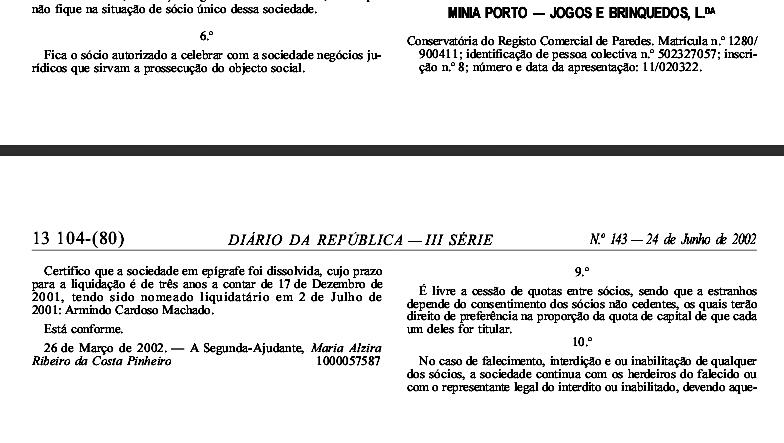
Majorette ran at a loss in 1989, and during the following years the situation didn't improve. By the end of 1992, Emile Véron and his son Alexandre had to call for meeting of creditors, and a few months after that (April 1993), the company was sold to Ideal Loisirs. After some years, in 1996, the company had to be rescued again by Triumph-Adler, that had a big plan to make Majorette competitive again. The production was centralized in Lyon, but many factories (including these in Portugal) were moved to Thailand, between the years 1999 and 2000. Was this the end of Minia Porto? It seems so. The company was wound up shorty afterwards.

Taken from Diário de República - Suplemento Sumário II Serie Parte B (24th June 2002)

 Novacar models are currently quite rare to find, although this rarity doesn't mean high prices. They are quite affordable for all those who are interested in acquiring a Portuguese "curiosity" or for Majorette "completists".

I have somewhere the yellow Ferrari 348, so I will update the article, as soon as I can photograph it. Here it is:


Hope you liked this article, it took a lot of effort to write it, since a lot of information available in other websites has been proved to be wrong.

FACTS AND FIGURES:
  • Name: FERRARI 348 GTB (Ref 101) and RENAULT ESPACE AMBULANCE (Ref 110/10)
  • Scale: 1:64 (approx.)
  • Year: 1994
  • Company: Novacar (Portugal) / Majorette (France)
  • Size: approx. 7.5 cm