Wednesday, June 8, 2011

#26 MADELMAN 2050 – ZAN and LAGARD (1988)


At the end of the eighties, many figure collections in 3¾’’ size were made and sold everywhere. The reason for that was obviously the great success that G.I.Joe became those years with their ARAH (A Real American Hero) series. In Spain, (one of) the company (companies) that tried to repeat the success of Hasbro was Exin. Exin had bought the rights of Madelman when Madel went in bankruptcy in 1983. The Catalonian company planned the figures as a sci-fi, futuristic heroes (Hombres C.O.T.A. – C.O.T.A. Men) in war against some extraterrestrials Earth invaders (Zarkons)
The figures were made with high quality, with great moulds and paints, but their most remarkable characteristics were their special features: the villains have a double face (reptilian and human). The reptilian identity is revealed when one of the heroes stands in front of one villain, and this is possible because of magnets hidden in the chests of the figures. Both the C.O.T.A. men and the Zarkons had magnets at their feet, which allowed them to stand upside-down in the Basetron 2050, which was built with some metal parts.

Enlarge to see the special features at the right side of the backcard, and the catalogue (figures and vehicles) of the first wave at the left side.

The plastic casts of the figures are absolutely great. Their only flaw could be the slightly thin arms. Considering that the series had a lifespan of only one year, the variety of casts is absolutely great: all 8 figures are different and have different weapons! This is not true for the vehicles, which share some common parts with other vehicles. The second series was planned with a few figures made of new casts, but those were actually never produced massively. The only figures released from this 2nd series were repaints of two figures from series 1 (apart from the Clonstar pilots).

The figures were more fragile than their American counterparts, and their arms broke sometimes during the play. Their waist articulation is very resistant (no O-ring), and we have to highlight the magnet feature, rarely seen before in an action figure collection.

The figures were not a great success at the time. Maybe they came 1 or 2 years too late, or maybe the thematic was too different to G.I.Joe: ARAH. Hasbro´s collection was very popular in 1988 in Spain and, although Exin’s line was serious and very well done, it had very few chances to success. We recognise the great bravery of the spanish company trying to compete with a quality product, instead of just copying the Hasbro soldiers like other companies did (for instance Unifighters –Galoob- or the Corps! –Lanard-). At their market release, the figures were priced slightly cheaper than G.I.Joes (around 600 pesetas instead of 800), but shortly afterwards, it wasn’t strange to see 2x1 offers in toy shops.

Comic book included

Exin even created several comic books in which the history of the Madelman 2050s was explained. These comics remind quite a lot to those from Masters of the Universe. 4 of them were printed. All the figures in this first wave included the same comic book, that’s the one with the title: “La Invasión de los Zarkons” (Zarkons’ Invasion). Curiously, the comic is copyrighted earlier than the figures (December 1987).

The first series (1988) consists of 8 figures, the fortress Basetron 2000 and several vehicles. The second series (1989) was partly manufactured because of the early cancellation of the series. Only a few of the figures and vehicles displayed were built for the market, and they are very difficult to find. The rest were probably just prototypes.

The first two figures I wanted to show are the commanders of each faction: Zan and Lagard (Reference Numbers 1500 and 1600). Zan is described in the box as: “Commander and Pilot of the C.O.T.A. Men”, while Lagard is “Commander of planet Zarkon’s first attack unit”. They include the above mentioned comic book, and their box has an amazing artwork that can be counted among my favourite artworks for toys. The card’s halves were glued together, but with the years, the glue dried, and they do not stand together anymore. Because of this, the comic book is sometimes lost.

Zan also includes the little robot named "Mascota" (in english "Pet" or "Mascot"). Curious about this figure, is that its head is inspired by the Madelman figure from 1977 known as "Suárez" (that received its name because of its resemblance to spanish president Adolfo Suárez, who won the first democratic elections that same year). Here's a comparison among them.

Comparison between President Suárez, Madelman Suárez '77 and Madelman 2050 Zan '88. Original pic courtesy of Juan (Madelman Blog Show), modified by myself.

Update: M2050 Comic Book #1 "La Invasión de los Zarkons"


NOTE: This article will be continued soon, with more figures from the first series, as well as many other interesting facts.

FACTS and FIGURES:
  • Name: ZAN (Ref. 1500) & LAGARD (Ref. 1600)
  • Toy Line: Madelman 2050 (Wave 1)
  • Year: 1988
  • Company: Exin (Spain)
  • Size of the figures: 3¾’’ or 9,5 cm

Sunday, June 5, 2011

#25 KIDCO – BURNIN’ KEY CAR KNIGHT 2000 (1982)


Kidco is somehow a very rare toy company. It only existed during a few years, and their models are difficult to find. These are not specially detailed, or well-made; I just guess the company didn’t have the time to improve its fabrication methods, before it...changed its name.

In the world of the scale cars, it sometimes happens, that one brand is interconnected with many others. This won’t be an exception. Kidco was founded in 1977 in Besenville, Illinois, and it was nothing else than a marketing arrangement to sell the toys from Universal Toys in America. This other company was producing scale cars in Macau and Hong Kong, under the management of David Yeh. The models made and marked with the Kidco brand first appeared in 1979 and disappeared around 1983-84. 

The end of the company came, when David Yeh and his group (Universal Group) acquired Lesney and Matchbox in 1982, after the British company went bankruptcy and into receivership (except the yesteryear line, which was acquired by Lledo). At this point, Universal shifted from Kidco to Matchbox (now Matchbox International), and this is the reason why since the mid-80s, many Matchbox models were made in Macau, and later in China. And the reason why Kidco as a brand disappeared.

Matchbox would remain in the hands of Universal Group, until 1992, when the brand was sold to Tyco Toys.

Kidco made this wonderful reproduction of the “Knight Rider” in 1982, with metal base, but plastic bodywork. Level detail is low. Windshields are all black to hide the spring mechanism inside, which allows the car to be “shot” using a key. The key was obviously provided with each car, and the keyring was always decorated with the name of the car, so there’s a different keyring for each different model.

During these years Kidco produced for this “Burnin’ Key Car” series several toy cars that appeared in popular TV shows, like the A-Team van or at least two cars from Magnum P.I.. This car is also showed in the review.


At the base of the black car, we can still read a copyright symbol with the words Universal Studios 1984, what means, that the product was officially licensed. It surprises me a bit, that if they had the license, they used “Knight 2000” instead of “Knight Rider”, but we’ll probably never know. The Magnum Ferrari 308 GTS has the T.M. after the name of the car: Magnum p.i. T.M., so it is also a licensed product, but this time from 1980.

In the normal series, these cars were also reproduced, along with cars seen in movies like Cannonball Run or TV-series like Emergency. The “Demolition Set” was also released in 1983, and it was a playset in which the cars could be shot against several obstacles and ramps.

Several years later, these cars were sold under the Matchbox brand. The cars were exactly the same, as it can be seen in this catalogue from 1987. Note that the two cars I have presented are not in the list, probably because at that time, the TV series "Knight Rider" and "Magnum p.i." were not on air anymore, and it wasn't commercially interesting to release them. The series "Demolition Cars" were also available a few years earlier under the Kidco brand.

Page from Matchbox Catalogue from 1987. Scan found in MatchboxPeru.com.

Special thanks to Speedy who put me on the track to the Matchbox series.

UPDATE: I found the same model made by Matchbox and comparing their casts, I have observed subtle differences between them (wheels, base, side spoilers). Here a few pictures:


UPDATE2 (Nov/2019): Here is a curious launcher by Kidco that is decorated with the same colours and stickers of the Knight 2000. I think it must belong to another model, since this model has no need to be launched, as it comes with the "firing-key" mechanism inside. Any ideas where does this come from?


UPDATE (Jun/2023): This is the Matchbox model of the Pontiac Firefird, with no reference to the Knight 2000. Instead of this text, the toy displays red and blue sports stripes on both sides and over the bonnet.


FACTS AND FIGURES
  • Name: Knight 2000 (Pontiac Firebird) and Magnum p.i. (Ferrari 308 GTS)
  • Scale: 1:64 approx
  • Year: 1982 and 1980
  • Company: Kidco (U.S.A.) and Matchbox (Great Britain)
  • Size: approx. 3’’ or 7 cm

Thursday, June 2, 2011

#24 MASTERS OF THE UNIVERSE – MEKANECK and JITSU (Refs. 4919 and 4924) (1984)

My first and only review to date dealing with the Masters of the Universe is #12 (Castle Grayskull), and according to blogger stats, is one of the most successful ones in TFTP. I wanted to write another article about this wonderful series of figures, one of my favourite lines of all times. This time I’ll talk about two figures from the third wave, released in 1984: Mekaneck and Jitsu.
The third wave was somehow a transition between the first two series and the rest of the collection. Wave 1 figures had only the “waist twisting” action, figures in the second one, too (except Ran-Man, which was made of a completely different way, Man-E-Faces, with his changing faces, and Trap-Jaw, who had movable jaws. These features are nothing compared with what it is to come from wave 4 on. Both figures that I present today have great features:
-Mekaneck is the “human periscope” of the heroic warriors, and can extend his neck to have a better point of view. His glasses are chromed and look like mirrors. Mekaneck came with a yellow club and a red removable two-part armor.

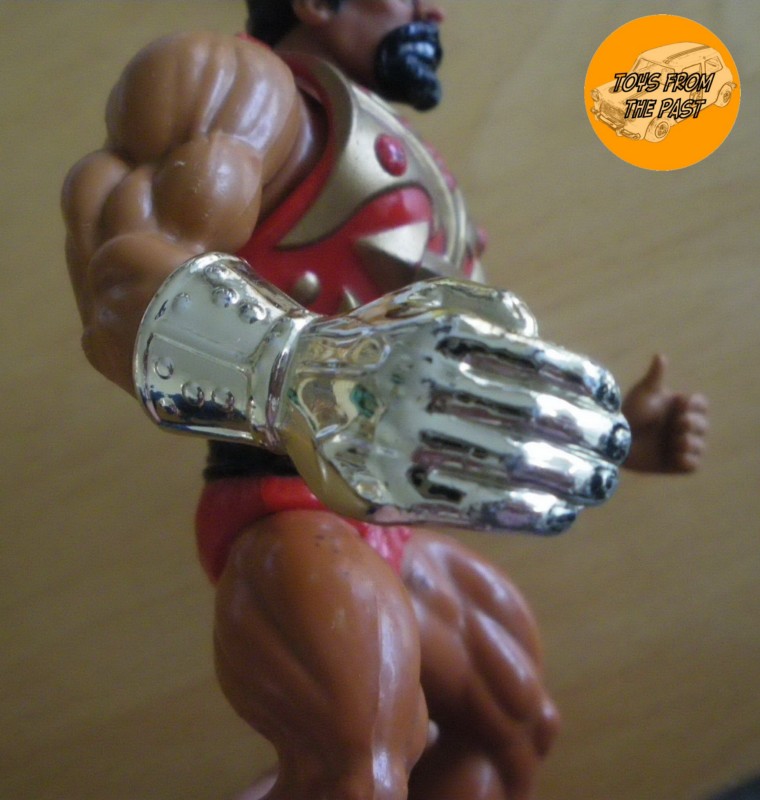
-Jitsu is the "evil master of martial arts", and his special movement is a punch with his right hand. His hand is golden, although with the time, it tends to loose its glitter. The figure came with a orange sword and a red removable two-part armor.

With the third wave, the popularity of the series kept growing, reaching the top during the series 4, with the new, third-party, “evil Horde”, and new and exciting features. The popularity of series 4 (and its sales), were so high, that Mattel probably gave a blank check to the designers to do what they wanted from wave 5 on. Only this way can be understood, that Masters of the Universe released in 1985 the largest playset in this collection (and probably one of the 5 largest action figure's playsets of all times), named Eternia.
Going back to the figures, they are 5½’’ tall (14 cms), and almost all of them, have this characteristic form, with very muscled torso, arms, and legs. There are different moulds for arms, chests, and legs, but they all look very similar. If you compare the pics, these two figures share exactly the same mould, except for the head... and well, Mekaneck’s torso has been modified a little, due to his action feature.
The colours of the figures are varied, although “human” or “human-similar” characters usually have skin-color bodies. Jitsu and Mekaneck are humans. Mekaneck seem to be wearing some kind of tigh dress, see his hands and face.


Detail photos of the Makaneck’s neck and Jitsu’s fist.
FACTS and FIGURES:
  • Name: MEKANECK (Ref. 4919) and JITSU (Ref. 4924)
  • Toy Line: Masters of the Universe (Wave 3)
  • Year: 1984
  • Company: Mattel (U.S.A.)
  • Size of the figures: 5½’’ or 14 cm

Monday, May 30, 2011

#23 GUISVAL – SEAT 850 & LAMBORGHINI MARZAL (1967 and 1970)


Many of the car collectors reading these lines may have not heard about Guisval. If you are not Spanish, it won’t be surprising. If you’re Spanish, you have not only heard from them; you have probably owned many of these miniatures sometime, or you have bought them as a present for children.

Guisval is the most successful die-cast miniatures manufacturer in Spain. Their models are in the market since 1967, and (specially before the 90s) they could be adquired almost anywhere: not only toy shops, but also in newsagents, or candy shops. The reduced price, the detailed models, how tought they were made, and a very wide variety of colors and decorations, were not overlooked by parents.

Francisco Guillén Verdú founded a company with his name in 1962, which originally built some toy watches, toy typewriters and some ships and submarines. This company changed its name to Guisval in 1967, when two friends of him joined to this project. Their names were: Guillén, Serralta and Valero, and the company was renamed to Guisval, using the first syllables or letters of their surnames (GUIllenSerraltaVALero). These three friends met while they were working for Payá, another toy company, that exists since 1909 in the town of Ibi (Alicante). Ibi has been the center of the Spanish toy industry during decades, and still is, although the industry nowadays is much weaker.

It all started in a basement in Ibi (1962). Picture by: Francisco Guillén Verdú, courtesy of Xavier Arumi (www.rosaspage.com)

With the change of the name, they start producing 1:64 scale cars, which is for what they are best known. This series is known as “Campeón”, and it exists even today. The quality of the models has decreased with the years (that will be commented in future entries).


To illustrate this article about the history of Guisval, I have taken two of the oldest models I have. One of them was first released in 1967, the Seat 850 was a very common car those days in Spain. The other was first made in 1970, and represents a Lamborghini Marzal.


Specially distinctive are the wheels, consisting of two parts (first version in Seat, second version in Lamborghini), the metallic basis and the “fabricado en España”, which was in later models translated to English. Note that the logo in the Seat seems to be a little older than in the Lamborghini. Both models were made in more than one color, but always sold under the reference numbers: 32 – Seat 850 Coupé/Rally and 41 - Lamborghini Marzal.

Matchbox also made a Lamborghini Marzal in approximately the same scale.

FACTS AND FIGURES
  • Name: Seat 850 Coupé/Sport and Lamborghini Marzal (Nr. 32) (Nr. 41)
  • Scale: 1:64
  • Year: 1967 and 1970
  • Company: Guisval (Spain)
  • Size: approx. 3’’ or 7 cm

Saturday, May 28, 2011

#22 1000 VIEWS!

This blog has already received over 1000 visits! Thanks to all who made this possible! I have already published nearly 20 toy reviews and this is (hopefully) just the start. Much more reviews are coming.

Stay tuned for what’s coming next!

By the way… articles #10 and #13 have been updated with new pictures.

Thursday, May 26, 2011

#21 REAL GHOSTBUSTERS – FRIGHT FEATURES’ EGON SPENGLER and WINSTON ZEDDMORE (1988)


The Real Ghostbusters was never a popular TV series in Spain. At least I don’t remember watching it on TV. It’s quite surprising that these figures made the whole way to my country. Here’s the story (it took a few years) of how they arrived to Spain.
 
The figures were first available in Spain around 1992. I remember that day in which some friends of my parents came to spend a few days at home with their son. We passed by a Spanish well known department store (El Corte Inglés) and our parents bought a figure for each of us. He took Peter Venkman and I took Ghost Post. If it wasn’t for him, I would have probably never bought any figures of this series.
The Fright Features series (2nd wave - see photo with card) was the first (and probably the only) which was ever sold in Spain, and I don’t think all those items were actually available. During the early 90s, many toy lines which were not available in Spain, were imported to be sold in El Corte Inglés. Otherwise, very strange toy lines like Galoob’s Unifighters, Olmec’s Bronze Bombers or Kenner’s Real Ghostbusters would have never been available there.
Click to enlarge and read the importer's information


So what happened between 1988 and 1992? Probably these figures and vehicles were leftovers, that weren’t sold in other European countries. Note that the card is written in French and Dutch. Some exporters –Loustau and Sachnovsky– brought them, and offered them to El Corte Inglés. The figures were not available anywhere else, and (maybe for this reason) they were not a big success in Spain. 

The actual card that you see in the pic, was from a figure I bought myself (when I was maybe 12) in a 2x1 offer. That means, that the original price of one figure in 1992, was 850 pesetas (5,10 Euros), but they were later sold at half price (425 pesetas or 2,55 Eur).


Frigth Features!

Well, I don’t want to speak much more about import-export, otherwise I won't have much time to talk about these two wonderful figures. They are two of the four members of the ghostbusters: Egon and Winston. The figures from the second wave of this Kenner’s series, included a “fright feature” which could be activated pushing one arm. The figure seems to be very scared! This feature was in my opinion a great idea, it makes a lot of fun, and it’s very original. I have rarely seen something similar in other toy lines.
Egon opens his mouth, lengthen his neck, and his tie goes up. Winston has a most elaborate feature, in which his head turns 360º while he opens his mouth in a very funny expression.


Together with each figure, a ghost and a suitable weapon to trap it, were included. The ghost could in some way attack the figures but the humans could defend themselves with the trap weapon (see pics).


Instructions for both figures' features

FACTS and FIGURES:
  • Name: FRIGHT FEATURES' EGON SPENGLER AND WINSTON ZEDDMORE
  • Toy Line: The Real Ghostbusters (Wave 2)
  • Year: 1988
  • Company: Kenner (U.S.A.)
  • Size of the figures: 14 cm approx.